
What an AI App Blueprint Generator Should Do
Most people do not get stuck on the app idea. They get stuck one step later, when that idea needs to become a real system. That is exactly where an ai app blueprint generator earns its keep. If it only gives you a clever concept and a few feature suggestions, it is not solving the hard part. The real job is turning intent into structure so you can build, test, and ship with fewer wrong turns.
For founders, creators, operators, and technical teams, the gap between idea and execution is usually expensive. You can lose weeks deciding which model to use, how prompts should be structured, what workflow logic belongs where, and whether your product can even be monetized in a practical way. A strong blueprint generator compresses that uncertainty into something usable. It should not replace your judgment. It should give your judgment a sharper starting point.
What an ai app blueprint generator really is
An ai app blueprint generator is not just a prompt tool with better branding. It should function more like a system design accelerator. You describe the product you want to build, the users you want to serve, and the outcome you need. In return, you should get a structured plan that connects product thinking with technical execution.
That plan should go beyond surface-level brainstorming. A useful blueprint outlines the app concept, core features, user flow, AI logic, prompt architecture, recommended stack, data considerations, and deployment path. In stronger versions, it also includes monetization angles, role-based workflows, and implementation priorities.
This matters because AI products break when the connective tissue is missing. A decent landing page concept and a decent chatbot prompt do not automatically become a working app. Someone still needs to define how the user interacts with the system, what happens behind the scenes, where model outputs are validated, and how the experience stays reliable at scale.
Why builders need more than ideas
A lot of AI tools are optimized for inspiration. That sounds useful until you are the one trying to ship. Inspiration gives you ten directions. Execution demands one clear path.
That is why ambitious builders tend to outgrow generic idea generators fast. If you are launching a customer support copilot, an internal workflow agent, a content automation app, or a voice-driven assistant, the challenge is not naming the product. The challenge is specifying the product well enough that you or your team can build it without rewriting the plan every two days.
An ai app blueprint generator should reduce that friction. It should help you answer practical questions early. What are the core user actions? Which prompts are static and which are dynamic? Does the app require memory, retrieval, external APIs, moderation, analytics, or human review? What should be built first, and what can wait until version two?
Those answers create momentum. They also expose weak ideas before you sink time into them, which is just as valuable.
The outputs that actually matter
If you are evaluating blueprint tools, the standard should be high. A useful output is not a wall of generic text. It is a build-ready document with enough specificity to move into development, testing, or product validation.
The strongest blueprint generators usually produce several layers of detail. First comes the product framing – what the app does, who it serves, and what problem it solves. Then comes the operating logic – key features, user journey, system components, and prompt flows. Finally, there is the execution layer – technical recommendations, deployment notes, business model options, and go-to-market guidance.
That last layer gets ignored too often. Plenty of tools can sketch a product. Fewer can help you think through whether it should be sold as SaaS, packaged as a service, offered internally, or used as a lead-generation engine. For solo builders and lean teams, that distinction matters. The best blueprint is not the one with the most detail. It is the one that points toward a viable product.
Where weak blueprint generators fall short
There is a difference between speed and shallow output. Many tools promise instant app plans, but what they generate is too vague to trust. You will see feature lists with no prioritization, prompt suggestions with no logic behind them, and architecture notes that could apply to almost anything.
That kind of output creates a false sense of progress. It feels productive because the document looks polished. But once you start building, the missing decisions come back all at once.
A weak generator also tends to flatten complexity. It may treat a simple single-user assistant and a multi-role workflow platform as if they require the same planning depth. They do not. A lightweight utility app might need a narrow prompt chain and basic storage. A team-facing AI system may need permissions, routing logic, auditability, fallback flows, and integration planning. Good tools reflect that difference instead of pretending every AI app can be templated the same way.
What to look for in an AI app blueprint generator
The best tools think like product architects, not just content engines. They should ask for enough context to tailor the output. Your industry, user type, desired business model, preferred complexity, and delivery format all affect the plan.
They should also produce modular outputs. That means separate sections for features, prompts, workflows, architecture, deployment, and monetization instead of blending everything into one broad narrative. Modular structure makes it easier to hand off work, validate assumptions, and upgrade pieces of the system later.
Another strong signal is whether the generator understands real AI implementation trade-offs. It should account for latency versus quality, flexibility versus control, and automation versus oversight. For example, a public-facing legal or healthcare assistant needs a different safety posture than a private brainstorming tool. A good blueprint does not hide those trade-offs. It surfaces them early.
From learning to shipping faster
This is where the strongest platforms separate themselves from isolated generators. A blueprint is powerful, but only if the person using it knows how to turn it into a working system. That is why education matters as much as automation.
If you understand prompt engineering, workflow design, agent behavior, and deployment basics, you can stress-test the blueprint instead of blindly following it. You can spot weak assumptions, improve the prompt stack, and adapt the architecture to your constraints. That is a major advantage over using disconnected tools that generate plans without helping you build the capability behind them.
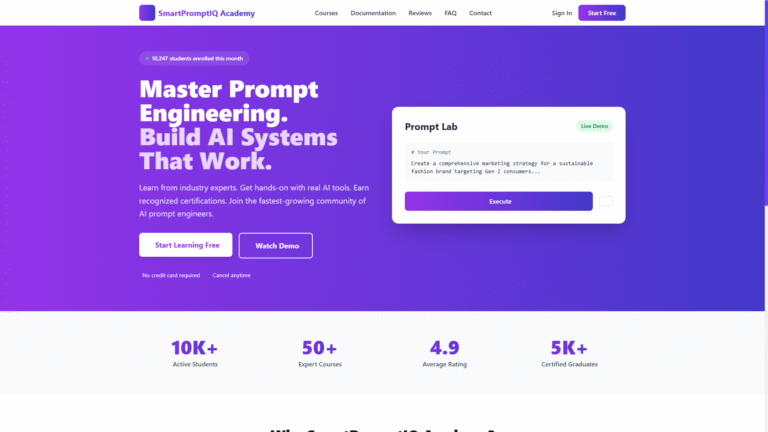
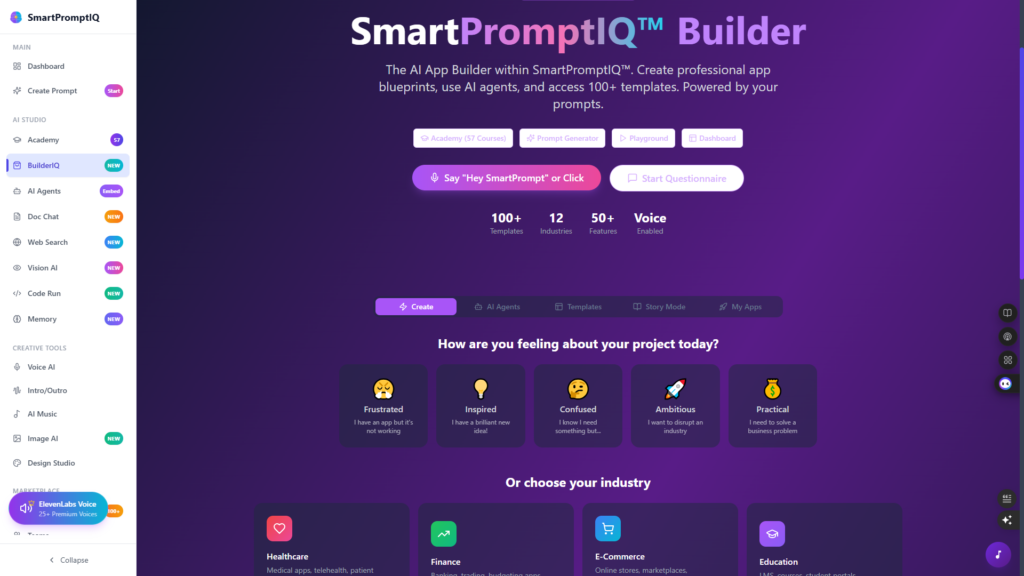
SmartPromptIQ is built around that exact progression. You learn the skills, use the builder tools, and move toward production-ready systems with far less guesswork. For builders who care about execution, that combination matters more than another one-click AI demo.
Who benefits most from this kind of tool
An ai app blueprint generator is especially useful for people who move fast and need clarity early. Solo founders can use it to pressure-test ideas before hiring or building. Agencies can use it to turn client requests into scoped AI product plans. Product teams can use it to align business and technical stakeholders before development starts.
It is also valuable for people who are still building confidence in AI. Beginners often know the problem they want to solve but not the system design choices behind it. A strong blueprint gives them a bridge from concept to action. More advanced users benefit too, especially when they want to compress planning time or explore multiple product directions without starting from a blank page each time.
The one caveat is this: a blueprint generator works best when the input is thoughtful. If your app idea is vague, your output will be vague too. These tools amplify clarity. They do not create it from nothing.
The bigger shift behind blueprint-driven building
AI product creation is moving away from scattered experimentation and toward structured execution. That shift is healthy. It means builders are asking better questions, not just chasing faster outputs. They want systems that can be launched, refined, monetized, and maintained.
That is why blueprint generation is becoming such an important layer in the stack. It closes the gap between learning what AI can do and specifying what your product should do. It gives builders a more disciplined way to move from ambition to implementation.
If you are evaluating your next move, look for an ai app blueprint generator that gives you more than excitement. Look for one that helps you think clearly, build deliberately, and make smarter trade-offs before the first line of code or no-code workflow is even in place. That is where speed starts to become real progress.