
How to Turn Prompts Into AI Products
Learn how to turn prompts into AI products with the right workflow, system design, testing, and launch strategy for real-world use cases.

Learn how to turn prompts into AI products with the right workflow, system design, testing, and launch strategy for real-world use cases.

Explore the best no code ai tools for builders, founders, and teams who want to create agents, apps, and workflows faster without coding.
The difference between a business owner who works 60 hours a week and one who works 20 hours a week usually comes down to leverage. In 2026, the highest form of leverage is AI workflows. As we detailed in our Complete Guide to AI Prompt Engineering in 2026, building a centralized Prompt Library is how…
By SmartPromptIQ Team | June 2026 If you are building an autonomous business in 2026, the first technical decision you have to make is which foundational model to use. While there are dozens of Large Language Models (LLMs) on the market, the enterprise landscape is dominated by two titans: OpenAI’s ChatGPT and Anthropic’s Claude. As…
By SmartPromptIQ Team | June 2026 Just a few years ago, if you wanted to build an autonomous AI agent to automate your business, you needed a team of Python developers, API keys from OpenAI, and a massive cloud computing budget. The barrier to entry was incredibly high. In 2026, that barrier has completely vanished….
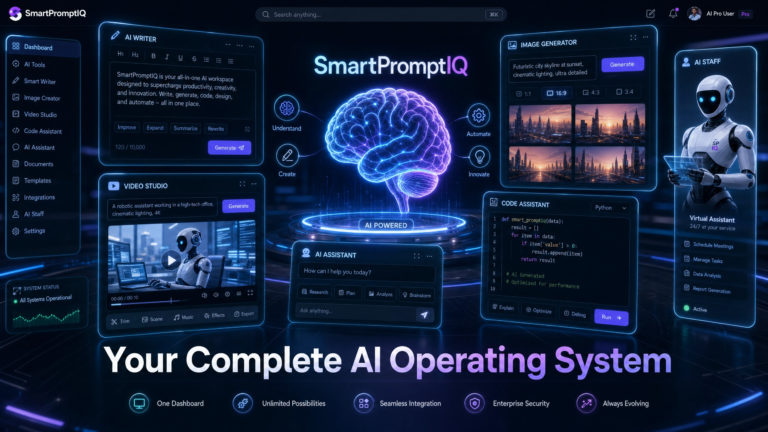
When generative AI first entered the workplace, the narrative was driven by fear: “AI is going to take our jobs.” In 2026, the reality is entirely different. AI did not take jobs; it evolved them. It created an entirely new category of high-paying, high-leverage careers centered around one core skill: prompt engineering. As we explored…
By SmartPromptIQ Team | June 2026 Marketing a small business used to require a massive budget. You needed to hire an SEO agency, a copywriter, a social media manager, and an ad buyer. If you could not afford them, you had to do it all yourself, usually resulting in burnout and mediocre results. In 2026,…
Real estate investing has always been a game of speed and data. The investor who can underwrite a property the fastest, contact the seller the quickest, and structure the best financing usually wins the deal. For decades, this required massive teams of analysts and acquisition managers. Today, the landscape has changed. Solo investors and small…
By SmartPromptIQ Team | June 2026 If you have ever felt frustrated because an AI chatbot gave you a generic, robotic, or completely incorrect answer, the problem was likely not the AI. The problem was the prompt. As we explored in our Complete Guide to AI Prompt Engineering in 2026, the quality of your output…
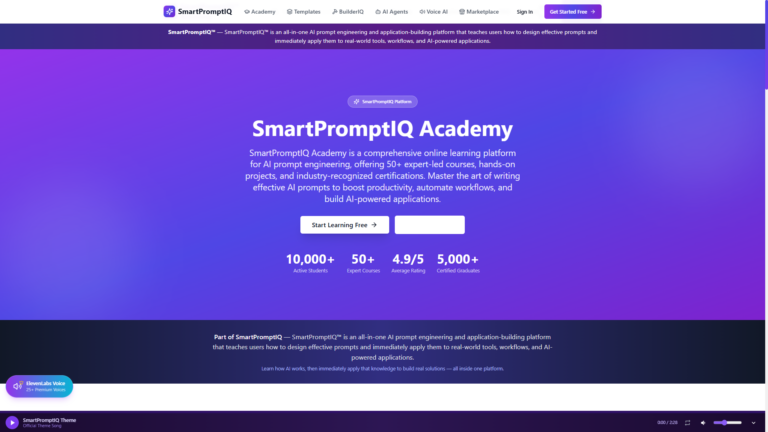
Smart Prompt IQ Academy positions itself as the world’s most practical platform for AI prompt engineering and AI tool education. Built to guide users from zero knowledge to real-world AI execution, the Academy does not stop at explaining concepts. Instead, it drives learners through hands-on prompt creation, tool generation, app blueprinting, and AI-powered workflows. Every…