
Best Prompt Engineering Course for Beginners
Most beginners do not need more AI hype. They need a prompt engineering course for beginners that explains what to do, why it works, and how to turn a blank chat box into useful output they can actually ship.
That is where many courses miss the mark. They teach clever prompt tricks, but not repeatable systems. You finish with a few screenshots, a handful of notes, and no real way to apply what you learned to product ideas, workflows, or client work. If your goal is to build with AI instead of just experiment with it, the course you choose matters.
What a prompt engineering course for beginners should actually teach
A strong beginner course should start by removing confusion, not adding jargon. You do not need a PhD-level explanation of transformers on day one. You need a practical framework for how large language models respond to instructions, context, examples, constraints, and iteration.
That means the early lessons should cover prompt structure in plain English. You should learn how role prompting changes output, why context improves relevance, when examples help, and how constraints reduce vagueness. More importantly, you should practice improving weak prompts into strong ones. That skill carries much further than memorizing formulas.
The next step is where quality starts to separate. A basic course may stop at one-off prompting. A better one teaches prompt workflows. Instead of asking the model for everything in a single message, you learn how to break work into stages – research, outlining, drafting, reviewing, refining, and formatting. That shift matters because real AI work is rarely one prompt and done.
For beginners with business or product goals, the course should also connect prompting to outcomes. Can you use prompts to generate customer support flows, content systems, product specs, research summaries, sales scripts, or agent logic? If not, the course may be educational, but it is not yet useful enough.
The difference between learning prompts and building systems
Prompt engineering sounds simple until you try to use it in the real world. A prompt that works once in a demo can fail when the input changes, the task becomes larger, or multiple steps need to connect. That is why beginners benefit from learning systems thinking early.
A good course should introduce the idea that prompts live inside larger workflows. The prompt is only one layer. You also need input design, output formatting, error handling, human review, and sometimes tool use or automation. Beginners do not need to master all of that immediately, but they should understand the bigger picture.
This is especially important for founders, creators, operators, and builders who want practical leverage. If your end goal is an AI assistant, a workflow engine, a lead-gen system, or a product feature, then prompt engineering is not the finish line. It is the control layer inside a larger system.
That is why a course with hands-on building tends to beat a course built around theory alone. You learn faster when each lesson creates something tangible.
How to evaluate a beginner prompt engineering course
The fastest way to judge a course is not by the marketing headline. Look at what happens after lesson three.
If the material quickly drops you into abstract terminology, it may be built for a more academic audience. If it stays too shallow and focuses only on novelty prompts, it may be optimized for clicks rather than skill. A useful beginner course balances simplicity with progression.
Here are the signals that usually matter most.
Clear learning path
Beginners need sequence. The course should move from fundamentals to increasingly practical use cases. Random lessons create friction. A structured path builds confidence because each concept has a purpose and a next step.
Real exercises, not passive watching
Watching someone else write prompts is not the same as learning. You should be asked to test, compare, revise, and troubleshoot prompts yourself. Even short exercises make a major difference because prompt engineering is learned through iteration.
Use cases beyond content generation
Content writing is a common entry point, but it should not be the whole curriculum. Strong beginner training should show how prompts apply to research, operations, product planning, support, automation, and agent behavior. That broader exposure helps you find where AI fits your work.
Focus on reliability
A flashy output is easy. A repeatable output is harder. Courses that teach evaluation, refinement, and prompt templates for consistency are usually more valuable than courses that chase impressive one-off results.
Path from learning to execution
This is the biggest differentiator. If a course helps you learn prompting but gives you no path to build tools, workflows, or production-ready systems, you may hit a wall right after finishing. For many beginners, that is exactly what causes momentum to die.
Common mistakes beginners make when choosing a course
One mistake is assuming the cheapest or fastest course is automatically the best starting point. Speed can help, but only if the material is organized well enough to create usable skill. A three-hour crash course may be fine for orientation. It is rarely enough for someone who wants to build meaningful AI workflows.
Another mistake is choosing based on the tool of the moment. Models change quickly. Interfaces change too. A course that focuses only on one platform feature can become dated fast. A stronger course teaches principles that transfer across tools, then shows how to apply them in current environments.
Beginners also often underestimate how much practice they need. Prompt engineering is not hard in the traditional sense, but it is iterative. You are learning how to communicate with precision, design repeatable instructions, and debug poor outputs. That takes reps. The best course will not just tell you this – it will build practice into the experience.
What the best beginner experience looks like
The best prompt engineering course for beginners does three things at once. It teaches the mechanics of prompting, shows how those mechanics support real use cases, and gives you a way to turn your learning into execution.
That last part is where many people gain a huge advantage. If you can learn prompt design and then immediately use builder tools to create app blueprints, AI agents, workflows, and technical specs, your progress compounds much faster. Instead of asking, “What should I do with this skill?” you start applying it while the learning is still fresh.
For that reason, platforms that combine education with build environments are often a better fit for ambitious beginners than course-only products. The trade-off is that they can ask more of you. You are not just consuming lessons. You are making decisions, shaping systems, and testing ideas. But for the right learner, that is exactly the point.
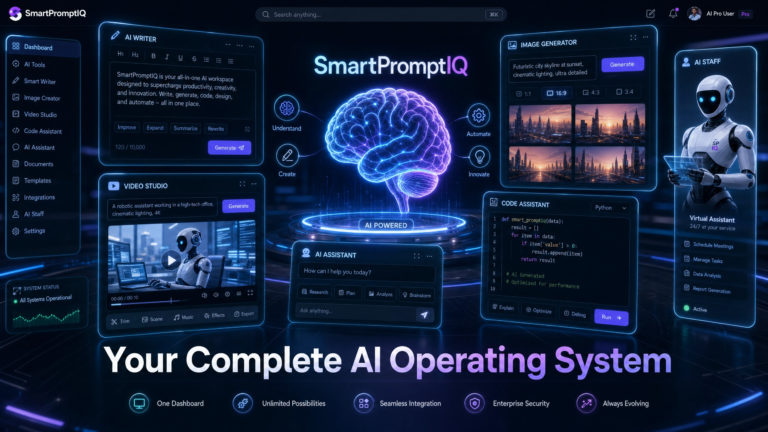
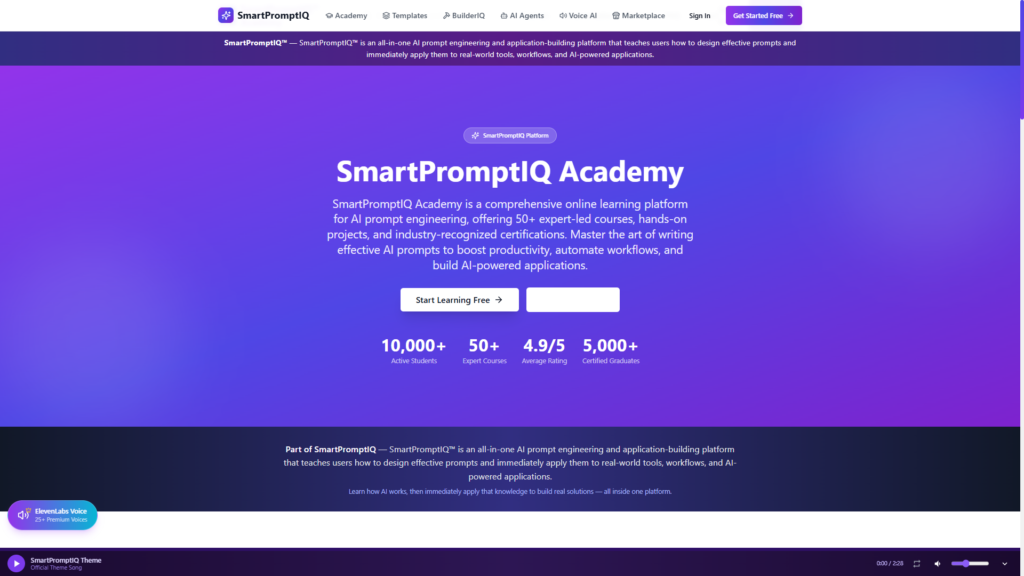
SmartPromptIQ fits that model well because it does not separate learning from building. A beginner can start with structured lessons, then move into creating prompts, workflows, agents, and product blueprints with a clearer sense of how everything connects. That makes the learning process feel less like isolated study and more like momentum.
How beginners can get results faster
You do not need to know everything before you start building. In fact, waiting for total confidence usually slows people down.
Start with one practical use case. Maybe you want to create a research assistant for your business, a content workflow for your team, or an onboarding bot for customer questions. Learn the prompting basics, then test them against that specific outcome. When prompts are tied to a real goal, improvement becomes easier to measure.
It also helps to keep a simple feedback loop. Write the prompt. Test it on varied inputs. Notice where it fails. Tighten the instructions. Add examples if needed. Define output format. Retest. This process is not glamorous, but it is where real skill develops.
Beginners should also learn when prompting alone is enough and when a larger setup is needed. Sometimes a single prompt solves the problem. Sometimes you need a multi-step workflow, retrieval from documents, or a defined agent behavior. Knowing the difference saves time and reduces frustration.
So which course should you choose?
Choose the course that respects your ambition. If you only want a surface-level intro, almost any beginner class can give you that. If you want practical skill that leads to usable AI systems, pick one that is structured, hands-on, and connected to execution.
Look for a course that helps you think clearly, not just type cleverly. Look for lessons that move from prompt basics into workflows, evaluation, and real outputs. And if your goal is to build something people can use, choose an environment where learning does not stop at the lesson page.
The best beginners are not the ones who memorize the most prompt formulas. They are the ones who learn fast, test often, and turn small wins into working systems.