
The AI Safety Playbook for Families Protecting Parents, Grandparents, and Loved Ones
AI Safety Playbook

Every family has its own way of showing care. We help our parents set up their new phones, we remind our grandparents to lock their doors, and we check in after a long drive. But today, the most urgent threats to our older loved ones are not physical; they are digital. The rapid rise of artificial intelligence has given scammers terrifying new tools to exploit the very bonds of family and trust that hold us together.
The financial impact is devastating. In 2025, online scams cost American seniors nearly $7.75 billion, a staggering 59% increase from the previous year . However, the true cost is measured in the emotional trauma, the loss of independence, and the paralyzing fear that follows a sophisticated scam. For adult children and grandchildren, the responsibility of protecting older relatives from these invisible threats can feel overwhelming.
Telling your parents to simply “be careful online” is no longer a viable strategy. When an AI-generated voice sounds exactly like you crying for help, or a text message perfectly mimics a bank fraud alert, “being careful” is not enough. Families need a concrete, actionable plan. This is the AI Safety Playbook—a comprehensive guide to securing your family’s digital life, supported by tools like SmartPromptIQ.
Play 1: The Family Code Word (Your Strongest Defense)
The most terrifying weapon in the modern scammer’s arsenal is AI voice cloning. Scammers only need a few seconds of audio—often pulled from a public social media video or a voicemail greeting—to create a near-perfect synthetic replica of your voice. They use this cloned voice to call your parents or grandparents, posing as you in a desperate crisis. They might claim they have been in a car accident, are locked in a foreign jail, or urgently need money for medical bills, pleading with the victim not to tell anyone else.
According to security researchers, one in three people who engage with these AI-powered calls end up losing money, with average losses exceeding $18,000 . The emotional manipulation is so intense that it completely overrides logical skepticism.
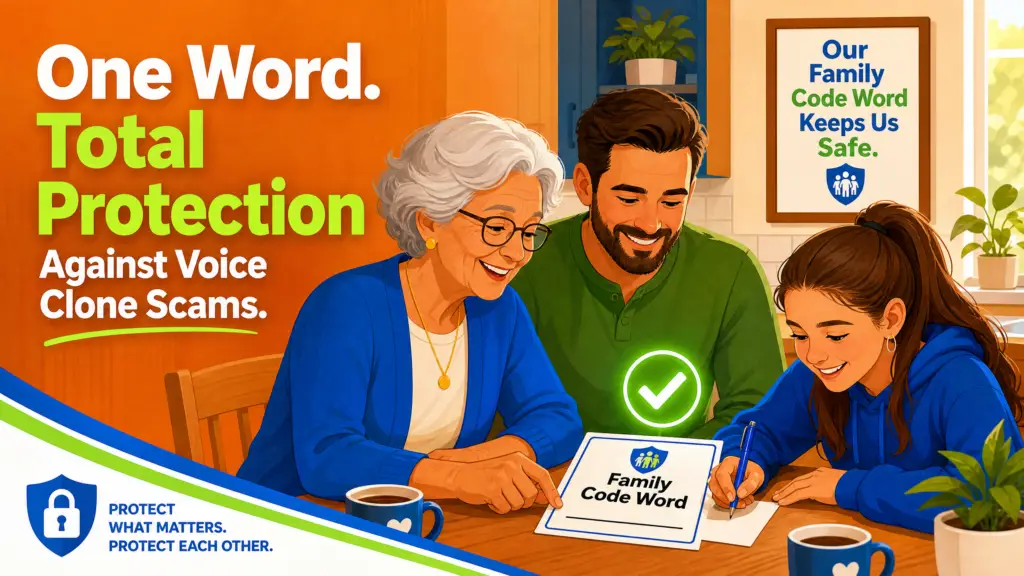
The Play: You must establish a Family Code Word immediately. Choose a unique, memorable word or phrase that only your family knows. If your parent receives a frantic call from someone sounding exactly like you, they must ask for the code word. An AI clone operated by a scammer will not know it.
To make this foolproof, use a Printable Safety Card. Write the code word down and tape it to the refrigerator or near the landline. Make it a physical, visible reminder that a familiar voice is no longer absolute proof of identity.
Play 2: The Call-Back Protocol
Scammers rely on urgency. They want your loved ones to act immediately, before they have time to think or consult with anyone else. This tactic is heavily used in fake government messages, tech support pop-ups, and bank fraud alerts. The Federal Trade Commission continually warns that legitimate government agencies will never demand immediate payment via text or email .
The Play: Institute the Call-Back Protocol. Agree as a family that no one will ever transfer money, buy gift cards, or give out personal information based on an incoming call, text, or email.
If your parent receives an alarming message from their “bank” claiming their account is locked, they must hang up or ignore the text. Then, they must independently find the official phone number (on the back of their debit card or a recent statement) and call the institution directly. By breaking the chain of communication initiated by the scammer, you neutralize the threat.
Play 3: Objective Scam Detection
Even with the Call-Back Protocol in place, sophisticated phishing emails and text messages can cause immense anxiety. When a message looks incredibly real, older adults may doubt their own judgment. They need an objective, stress-free way to verify suspicious communications.
The Play: Introduce your family to the SmartPromptIQ Fraud Analyzer. This tool acts as a digital second opinion. When your parent receives a confusing or alarming message, they can simply paste the text, email, or screenshot into the analyzer.
The tool provides an immediate, plain-language assessment of the message, identifying manipulative tactics like false urgency or unusual payment demands. It removes the burden of technical analysis from the senior and provides clear, actionable advice. Bookmark this tool on their smartphone and computer browser so it is always just one click away.
Play 4: Deepfake Awareness and Social Media Safety
AI image and video generators have made it incredibly easy to create deepfakes—highly realistic but entirely fabricated media. Scammers use deepfakes in romance scams, creating fictitious personas to build emotional connections with lonely older adults. They also use deepfakes of celebrities or trusted figures to endorse fraudulent investments.
Furthermore, social media is the primary hunting ground for scammers looking to harvest the audio and personal details needed for voice cloning and targeted attacks.
The Play: First, have an open conversation about deepfakes. Explain that seeing is no longer believing on the internet. If an online romance quickly turns into a request for money, or if a celebrity video is pushing a “secret” investment, it is a scam.
Second, audit your parents’ social media privacy settings. Ensure their profiles are set to “Private” or “Friends Only.” Remove their phone numbers and addresses from public view. The less information a scammer can scrape from their profile, the harder it is to target them with a personalized AI attack.

Play 5: Device Safety and Account Protection
As AI makes it easier for hackers to guess passwords and breach accounts, basic digital hygiene is more important than ever. A compromised email account can give a scammer access to banking details, personal contacts, and the ability to reset passwords across the web.
The Play: Spend an afternoon securing their devices and accounts. This is the most practical way an adult child can help.
- Enable Two-Factor Authentication (2FA): Turn on 2FA for their primary email, banking, and social media accounts. This requires a second form of verification (like a code sent to their phone) before allowing access, providing massive protection even if a password is stolen.
- Update Passwords: Ensure they are not using the same simple password across multiple sites. Help them set up a secure password manager.
- Install Updates: Make sure their smartphone, tablet, and computer operating systems are set to update automatically. These updates often contain critical security patches.
Play 6: Proactive Protection with an AI Staff Fraud Agent
The ultimate goal is to move from reactive defense to proactive protection. Just as scammers use AI to automate their attacks, families can use defensive AI to shield their loved ones. The FTC reports that consumers 60 and older are five times more likely than younger people to report financial losses from tech support scams . Preventing these malicious pop-ups and calls from reaching them in the first place is the best strategy.
The Play: Explore the use of an AI Staff Fraud Agent. These advanced, managed AI assistants can automatically screen incoming communications, flag known malicious numbers, and quarantine suspicious emails before they ever reach the inbox.
By utilizing structured **AI workflows** and accessible **prompt engineering tools**, these systems handle the complex technical work behind the scenes. This approach aligns perfectly with the need for an accessible AI business system that prioritizes user safety over complex functionality. It allows older adults to enjoy the benefits of the internet without constantly navigating a minefield.
The Most Important Play: Open Communication
The final and most crucial play in the AI Safety Playbook is maintaining open, non-judgmental communication. Scammers rely on shame to keep their victims quiet. If an older adult realizes they have been tricked, they often hide it from their family out of embarrassment or fear of losing their independence.
You must make it explicitly clear that falling for a modern AI scam is not a sign of cognitive decline or foolishness; it is a testament to the terrifying sophistication of the technology. Create an environment where your parents feel comfortable coming to you the moment something feels wrong, without fear of a lecture.
By implementing this playbook—establishing a Family Code Word, utilizing tools like the SmartPromptIQ Fraud Analyzer, securing their devices, and exploring defensive technologies like SmartProTradeIQ—you can build a robust protective shield around your family.
Do not wait for a crisis to strike. The threats are real, but so are the solutions. Start the conversation, implement the plays, and secure your family’s digital future today.
Try SmartPromptIQ AI Staff free and Download 50 AI Staff workflows to start your journey toward confident and safe AI usage today! Explore the possibilities at SmartPromptIQ AI Staff.
References
[1] AARP: FBI Report, Internet Crime Losses Hit $20.9 Billion
[2] WFTV: AI Voice Cloning Scams Cost Victims Millions
[3] Federal Trade Commission: Scammers Impersonating Government Agencies
[4] FTC: Protecting Older Consumers 2024–2025