AI Engineer Degree Requirements Explained
AI Engineer Degree

If you’re aiming for an artificial intelligence career, the biggest mistake you can make is assuming there is one fixed, rigid checklist for AI engineer degree requirements. There isn’t. A machine learning engineer at a large tech company, an AI product builder at an agile startup, and an automation-focused engineer inside a mid-market business can all need entirely different combinations of formal education, technical depth, and hands-on proof.
That is incredibly good news if you want to move fast in this rapidly expanding industry. It means the degree matters, but it is absolutely not the whole story. Employers in 2026 want clear signals that you can solve real problems, work intelligently with data pipelines, deeply understand large language models, and ultimately ship systems that perform in the real world — outside of a controlled classroom environment.
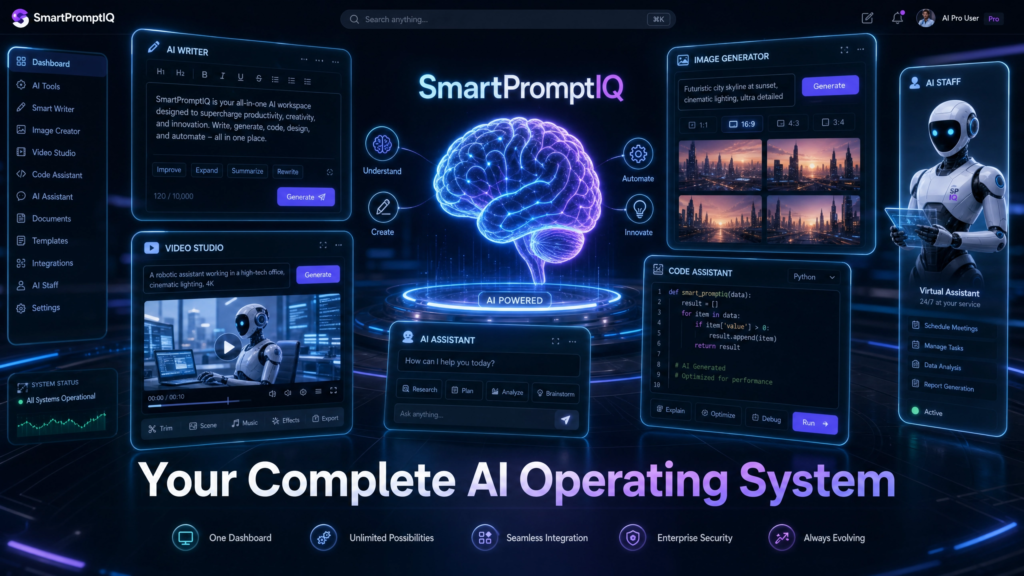
In this comprehensive guide, we will break down exactly what employers are looking for, which degrees carry the most weight, when you actually need a master’s degree, and how you can build an undeniable portfolio using tools like SmartPromptIQ Pro.
109%
YoY growth in AI job postings
$150K+
Average AI engineer salary
#1
Fastest-growing job title (LinkedIn 2026)
32%
Projected growth in data science roles
What Are the AI Engineer Degree Requirements?
In most cases, employers prefer a bachelor’s degree in a relevant, highly technical field. According to recent labor data, job postings requiring AI skills jumped over 109% year-over-year, making it one of the fastest-growing sectors in the global economy . With average salaries reaching well over $150,000 annually , the competition is fierce, and your educational foundation is the first filter hiring teams apply.
Computer science is universally the most common path, followed closely by data science, software engineering, mathematics, statistics, and electrical engineering. Some roles — especially research-heavy ones at frontier labs — may strongly prefer or strictly require a master’s degree. A PhD usually matters only for advanced theoretical research, building net-new foundational models, or leading specialized academic labs.
The key word is relevant. A degree in computer science tends to carry the most weight because it covers programming, algorithms, data structures, systems thinking, and often includes machine learning electives — mapping cleanly to what AI engineers actually do on the job.
But hiring teams do not just blindly scan resumes for a specific diploma title. They look critically at whether your education actually supported the skills the role needs. If your degree is in pure mathematics or physics, but you have strong Python projects, cloud model deployment experience, and a portfolio that shows practical execution, you can still be highly competitive.
The Degrees That Help Most
If you are planning your educational roadmap, here is how the top degrees stack up in the current hiring market:
Computer Science — The Gold Standard
Computer science is still the strongest all-around option. It gives you the software fundamentals that matter deeply because most AI engineers are not only training models. They are building APIs, managing complex data pipelines, handling cloud infrastructure, evaluating outputs, and integrating intelligence into actual, user-facing products.
Data Science
Data science is another solid path, especially for roles centered strictly on modeling, advanced analytics, experimentation, and predictive algorithms. The trade-off is that some data science programs are lighter on core software engineering principles — a gap that can become glaring if the job leans heavily toward deploying robust production systems.
Mathematics and Statistics
These degrees can be incredibly powerful if you want deeper command of probability, optimization, linear algebra, and the underlying logic of neural networks. They often produce exceptionally strong analytical thinkers, but you will likely need to supplement them with intensive, self-directed software engineering practice.
Electrical Engineering
Electrical engineering can be highly relevant if you are interested in the physical applications of AI: robotics, computer vision, edge AI, or embedded systems. For applied software product roles, it usually helps to add stronger experience in Python, cloud tooling (AWS/GCP), and machine learning frameworks like PyTorch or TensorFlow.
Do You Need a Master’s Degree?
Sometimes — but far less often than people think.
A master’s degree can help immensely if you want to specialize in deep machine learning, natural language processing (NLP), computer vision, or AI research. It can also strengthen your profile if your undergraduate degree was unrelated, or if you want to compete for highly sought-after roles at enterprise companies that still filter heavily by formal education.
Still, many applied AI engineering jobs do not require graduate school. If the role focuses on integrating existing models, building AI workflows, fine-tuning practical systems, or creating AI-powered applications, employers often care vastly more about whether you can build and ship code.
That trade-off matters. A master’s degree can deepen your theoretical understanding, but it also costs significant time and money. If your primary goal is to become an execution-focused AI builder, a faster route may be a relevant bachelor’s degree plus targeted upskilling, real-world projects, and undeniable proof that you can deploy working systems.
What Employers Actually Look For Beyond Degrees
This is where many candidates either separate themselves from the pack — or get filtered out entirely.
Most hiring managers treat the degree as an entry signal, not a final decision point. They want concrete evidence that you can use Python comfortably, work with complex data pipelines, deeply understand model behavior, and collaborate across engineering and product teams. They also want clear signs that you can move an idea from a messy prototype to a clean, scalable production environment.
That means practical experience with machine learning libraries, version control (Git), APIs, vector databases, cloud platforms, and evaluation methods often matters just as much as your major. If you can explain why a model underperformed, systematically improve it, and then integrate it into a usable product, you are speaking the language of the role.
The New Layer: LLMs and Prompt Engineering
Today, there is another critical layer. Many AI engineering jobs now heavily involve LLM application development, advanced prompt systems, Retrieval-Augmented Generation (RAG) workflows, agent design, orchestration logic, and human-in-the-loop evaluation. Traditional university programs do not always cover these bleeding-edge areas well.
So even candidates with strong formal education need applied learning that matches how AI products are actually being built right now. This is precisely why gaining certifications in prompt engineering through platforms like the SmartPromptIQ Academy can dramatically boost your resume and practical skillset — and it’s all included in a single Pro subscription.
AI Engineer Degree Requirements by Career Path
Not every AI engineer role is the same, so the education bar shifts significantly depending on what exactly you want to build and where you want to work:
| Career Path | Primary Focus | Typical Education Requirement |
|---|---|---|
| Applied AI Engineer | Integrating AI APIs into products and workflows | Bachelor’s in CS/Data Science + strong portfolio |
| Machine Learning Engineer | Developing, training, and deploying custom models | Bachelor’s minimum; Master’s often preferred |
| AI Research Engineer | Novel architectures, algorithms, and academic publication | Master’s or PhD highly preferred or required |
| AI Product Builder / Startup | Moving from idea to deployment rapidly for real users | Flexible — shipped projects can outweigh formal degrees |
Can You Become an AI Engineer Without the Perfect Degree?
Yes, absolutely. But you need a much stronger proof stack.
If your degree is adjacent, irrelevant, or unfinished, you can still break in by showing overwhelming technical competence and execution. That means building projects with real use cases — not just following toy tutorials in Jupyter notebooks. Build something that accepts real user input, processes live data, uses an AI model effectively, and produces a result people could actually use.
This is also where structured, practical education becomes incredibly valuable. You do not need more theory for theory’s sake. You need a path that helps you learn the skills, use the tools, and turn concepts into production-ready systems. Platforms like SmartPromptIQ fit perfectly into this shift because they connect AI learning directly to a builder’s outputs — from prompt systems to autonomous agents and automated workflows.
A Realistic Path if You’re Starting Now
If you are still choosing a degree, computer science is the safest, most versatile bet. Add electives in machine learning, data science, statistics, and software systems. Then, crucially, start building before graduation. Do not wait for permission from a university syllabus.
If you already have a degree, map your skill gaps honestly. Maybe you need stronger coding fundamentals. Maybe you understand Python but not cloud deployment. Maybe you know model theory but have never built an AI workflow that another person can actually use. Identify your weakest link and fix it first.
If you do not have a degree, your path is narrower but still entirely possible. Focus relentlessly on practical technical fluency, a highly visible GitHub portfolio, and outcomes that resemble real enterprise work. In many builder-driven corners of the tech market, undeniable proof can travel much further than pedigree.
The Smartest Way to Think About Degree Requirements
Ask a better question than, “What degree do I need?” Ask instead: “What kind of AI engineer am I trying to become?”
If you want research credibility, formal education matters more. If you want to build AI products, automate business workflows, or create useful systems for customers and teams, your edge comes from combining technical foundations with execution speed. That usually means some formal education, a lot of applied skill building, and consistent, public project work.
The market is rapidly shifting toward people who can do more than just talk about AI. It heavily rewards builders who understand the fundamentals and can turn them into something usable, testable, and deployable. A degree can open the door. Your work is what keeps it open.
Treat AI engineer degree requirements as a starting point, not a ceiling. Get the strongest foundation you can, then build faster than the average candidate is willing to. That is how credentials turn into capability — and capability turns into unstoppable career momentum.
🚀 Ready to Build Your AI Portfolio?
Stop reading theory and start building real AI applications. With SmartPromptIQ Pro, you get access to a 57-course Academy, professional certifications, and the ultimate suite of AI building tools — all for just $9.99/month.Start Building Today
If you are looking to fast-track your AI career or need enterprise-level AI marketing and development solutions, our team at K2-You.You Marketing and Development is here to help you scale. For inquiries, reach out to us at contact@smartpromptiq.net.
Published June 12, 2026 · SmartPromptIQ Blog · AI Careers
AI EngineeringCareer PathsDegrees & EducationMachine LearningPrompt EngineeringLLMs
References
[1] LinkedIn. AI Talent Salary & Hiring Report 2026. linkedin.com/pulse/ai-talent-salary-hiring-report-2026
Gwynedd Mercy University. How to Become an AI Engineer or Researcher. gmercyu.edu/academics/learn/become-artificial-intelligence-engineer