OpenAI Prompting vs. Smart Prompt IQ The Future of AI Workflows
Prompt Engineering Tools
AI Workflows
By SmartPromptIQ Team | July 2025 | 1,600 Words | 7 min read
The rapid evolution of artificial intelligence has fundamentally changed how businesses operate. From content creation to complex data analysis, AI is no longer a futuristic concept but a daily reality. However, the true power of AI is unlocked not just by the model itself, but by how we interact with it. This brings us to the critical discussion of prompt engineering tools and the evolution from manual OpenAI prompting to automated, intelligent platforms like Smart Prompt IQ. For entrepreneurs and businesses looking to scale, understanding this shift is crucial for maximizing productivity and ROI.
The Foundation: OpenAI Prompt Engineering
OpenAI’s language models, such as GPT-4, are incredibly powerful, but they require precise instructions to deliver optimal results. This process, known as prompt engineering, is the art and science of communicating with AI. [1] It involves understanding the nuances of language models and crafting inputs that guide the AI toward the desired output.
Understanding the intricacies of OpenAI prompt engineering is the first step toward mastering AI interactions. Source: LinkedIn / OpenAI
According to OpenAI’s official guidelines, effective prompting involves several key strategies that every user must master:
- Clear Instructions: Putting instructions at the beginning of the prompt and using separators like
###or"""to distinguish instructions from context. - Specificity: Being highly specific, descriptive, and detailed about the desired context, outcome, length, format, and style. Ambiguity is the enemy of good AI output.
- Examples (Few-Shot Prompting): Articulating the desired output format through concrete examples, which helps the model understand exact requirements.
- Zero-Shot to Fine-Tuning: Starting with simple zero-shot prompts, moving to few-shot if necessary, and considering fine-tuning for highly specialized tasks.
- Telling What to Do: Instead of just telling the model what not to do, explicitly stating what it should do instead.
While these best practices are essential for anyone using the OpenAI API or ChatGPT directly, they also highlight a significant challenge: manual prompting is time-consuming, requires specialized knowledge, and is prone to human error. [2] For businesses aiming to implement AI workflows at scale, relying solely on manual prompt engineering can quickly become a bottleneck that stifles innovation and efficiency.
The Rise of AI Automation for Entrepreneurs
As the AI landscape matures, the focus is shifting from simply “talking to AI” to building robust AI business systems. Entrepreneurs are increasingly seeking ways to automate repetitive tasks and integrate AI seamlessly into their operations. This is where the concept of AI automation for entrepreneurs becomes pivotal. It’s about moving beyond ad-hoc usage and embedding AI into the very fabric of the business.
Visualizing how AI workflows integrate into modern business operations. Source: 50skills.com
Manual prompting, while foundational, often lacks the scalability needed for enterprise-level applications. When every team member has to craft their own prompts from scratch, consistency suffers, and valuable time is lost. Imagine a marketing team where every writer uses a different prompt to generate social media copy; the resulting brand voice will be disjointed and confusing. This inefficiency has paved the way for a new generation of tools designed to streamline the prompting process.
The prompt engineering market is experiencing explosive growth, reflecting the critical need for better tools and methodologies. As businesses recognize the value of optimized AI interactions, the demand for platforms that simplify and enhance this process is skyrocketing. [3]
The projected growth of the prompt engineering market to USD 6,533.87 Bn by 2034 underscores the increasing demand for advanced AI tools. Source: Precedence Research
Enter Smart Prompt IQ: The Evolution of Prompting
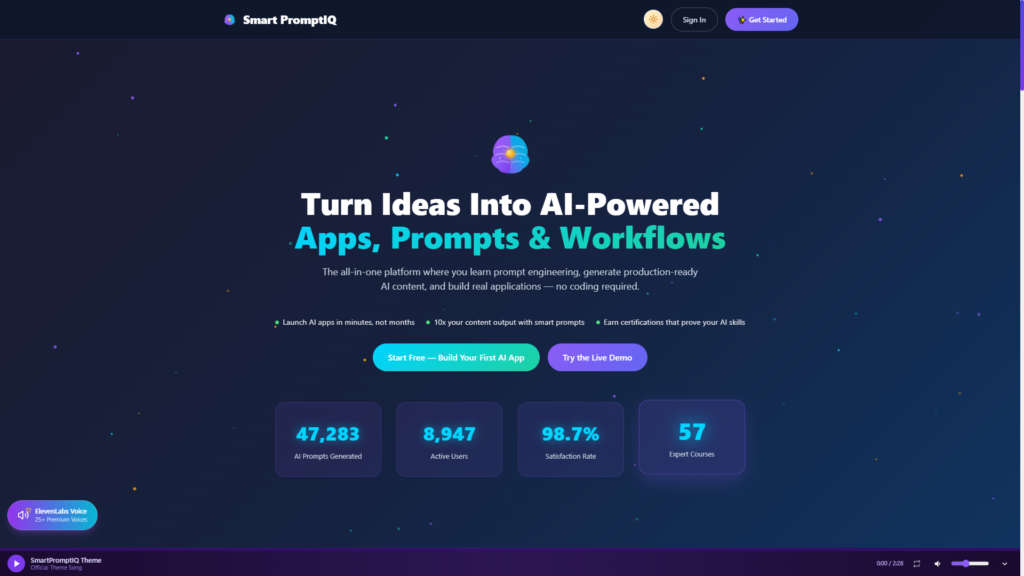
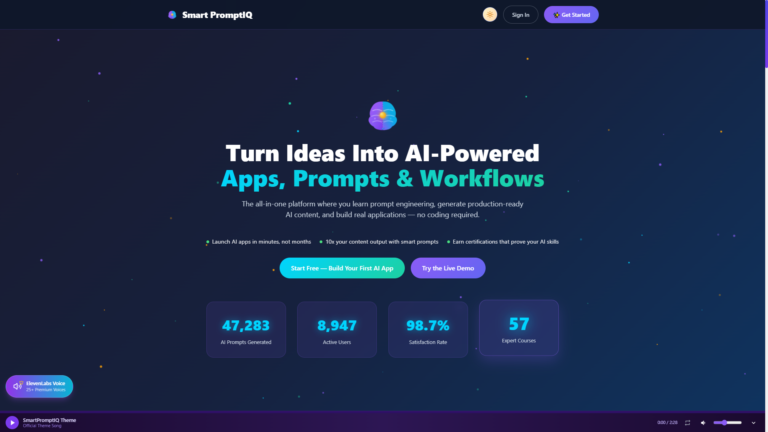
This is where platforms like Smart Prompt IQ revolutionize the landscape. Smart Prompt IQ represents a paradigm shift from manual prompt engineering to intelligent, system-driven AI interaction. It is designed to bridge the gap between complex AI capabilities and practical business applications, making it an indispensable tool for modern enterprises looking to gain a competitive edge.
What Makes Smart Prompt IQ Different?
While manual OpenAI prompting requires you to understand the nuances of the model, Smart Prompt IQ abstracts this complexity. It provides a structured, intuitive environment for generating production-ready prompts, building app blueprints, and deploying AI agents.
- Smart Prompt Generator: Instead of staring at a blank text box, users answer a series of smart questions tailored to their specific category. The platform’s AI then generates an expert-level prompt that incorporates best practices automatically.
- BuilderIQ for App Blueprints: Takes a plain English description and generates a comprehensive app blueprint, including features, architecture, and deployment plans.
- Pre-Built Templates: Over 100 battle-tested templates for various business functions, ensuring consistency and high quality across all AI-generated content.
- Team Collaboration: Share workspaces, manage prompt libraries, and track usage analytics across an entire team — transforming prompting from an individual skill into an organizational asset.
Bridging the Technical Gap
One of the most significant advantages of Smart Prompt IQ is its focus on accessibility. The platform is particularly beneficial for bridging the technical gap for adults over 50 and those transitioning into tech-centric roles. By simplifying the prompt creation process, it empowers users who may not have a background in computer science to leverage AI effectively. This aligns perfectly with initiatives aimed at workforce development and leveraging government funding opportunities for AI adoption.
Platforms like Smart Prompt IQ automate the strategies needed for optimal Generative AI results. Source: Brian Solis / OpenAI
Comparing the Approaches: Manual vs. Smart
To truly understand the value proposition, the table below compares manual OpenAI prompting with using Smart Prompt IQ across several key dimensions:
| Feature | Manual OpenAI Prompting | Smart Prompt IQ |
|---|---|---|
| Learning Curve | Steep; requires deep understanding of LLM behavior. | Low; guided by smart questionnaires and templates. |
| Time Investment | High; each prompt must be crafted and refined individually. | Low; generates expert-level prompts in seconds. |
| Consistency | Variable; depends on individual user skill level. | High; standardized templates ensure uniform output. |
| Scalability | Poor; difficult to manage across a large team. | Excellent; team workspaces and shared libraries. |
| Integration | Requires custom development using the OpenAI API. | Pre-built integrations, chatbots, and AI agents. |
Integrating AI Staff into Your Business
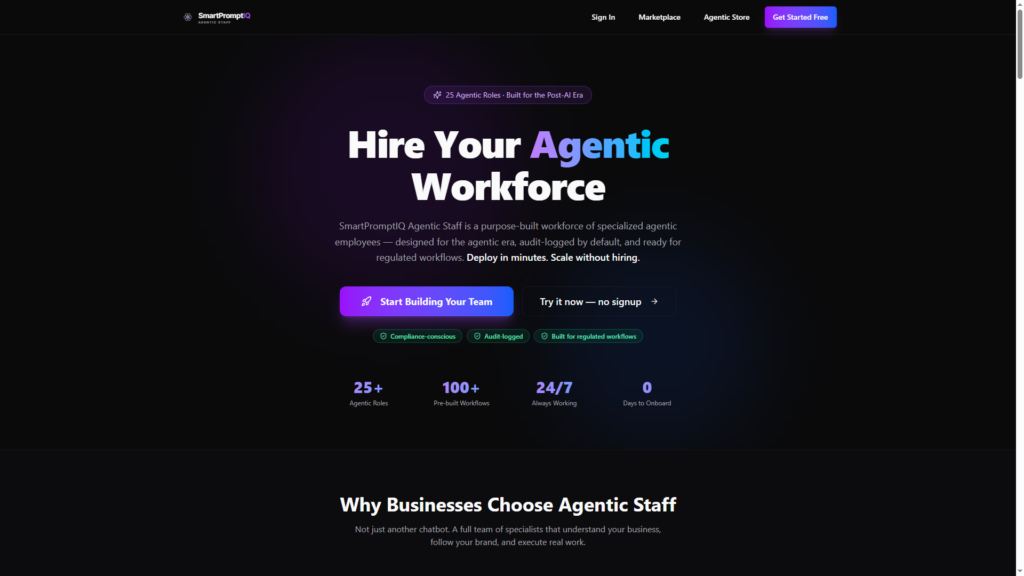
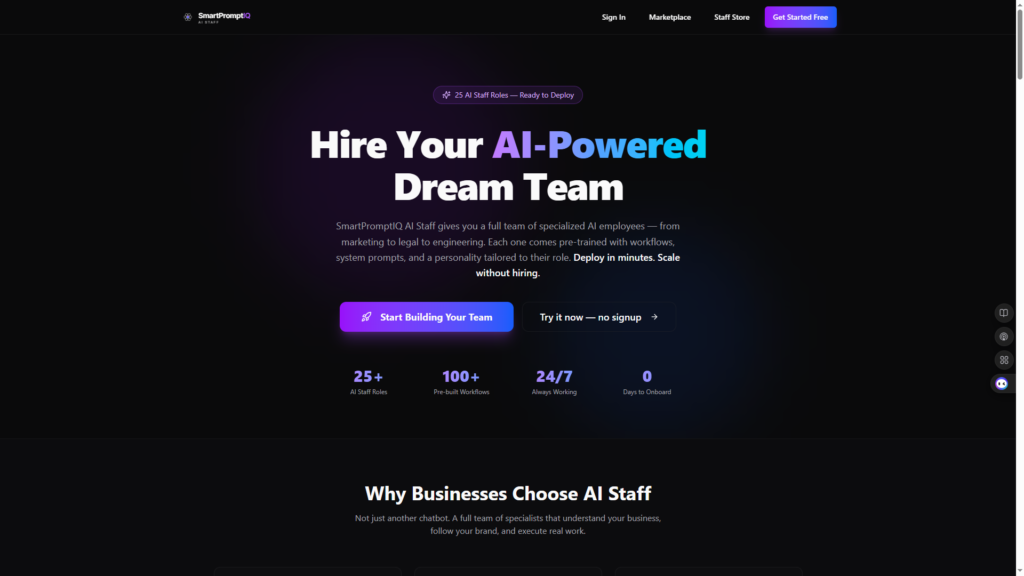
The ultimate goal of mastering prompt engineering — whether manually or through a platform — is to build effective AI workflows. This is where the concept of an AI staff becomes a reality. By utilizing tools like Smart Prompt IQ, businesses can deploy AI agents for business that act as virtual team members, handling tasks ranging from customer support to data analysis and content generation.
These AI agents are not just passive tools; they are active participants in your company’s success. They can be trained on your specific data, adhere to your brand voice, and execute complex workflows autonomously. For entrepreneurs, this means being able to scale operations without a proportional increase in headcount.
The Future is Automated
The debate between manual OpenAI prompting and using a platform like Smart Prompt IQ is not about which is “better” in a vacuum. It’s about choosing the right tool for the job. Manual prompting will always be necessary for researchers and developers pushing the boundaries of what AI can do. However, for businesses focused on productivity, efficiency, and maximizing ROI, intelligent prompt engineering tools are the clear path forward.
By adopting platforms that streamline the interaction with AI, companies can move beyond the experimental phase and start realizing the true business value of artificial intelligence. Whether you are a solo entrepreneur or managing a large team, investing in the right AI business systems is no longer optional; it is a competitive necessity.
If you are ready to explore how intelligent prompting can transform your business, consider the comprehensive solutions offered by SmartPromptAgents and see how you can integrate advanced AI workflows into your daily operations. For those looking to optimize their trading strategies, SmartProTradeIQ offers specialized AI tools tailored for the financial sector. Explore more smart resources at smartdealsiq.com.
🚀 Ready to Revolutionize Your Business with AI?
Join thousands of creators, founders, and teams who use SmartPromptIQ to turn ideas into AI-powered results every day.
✨ Try SmartPromptIQ AI Staff Free📥 Download 50 AI Staff Workflows