The Digital Skills Gap No One Talks About Adults 50–75 and the AI Revolution
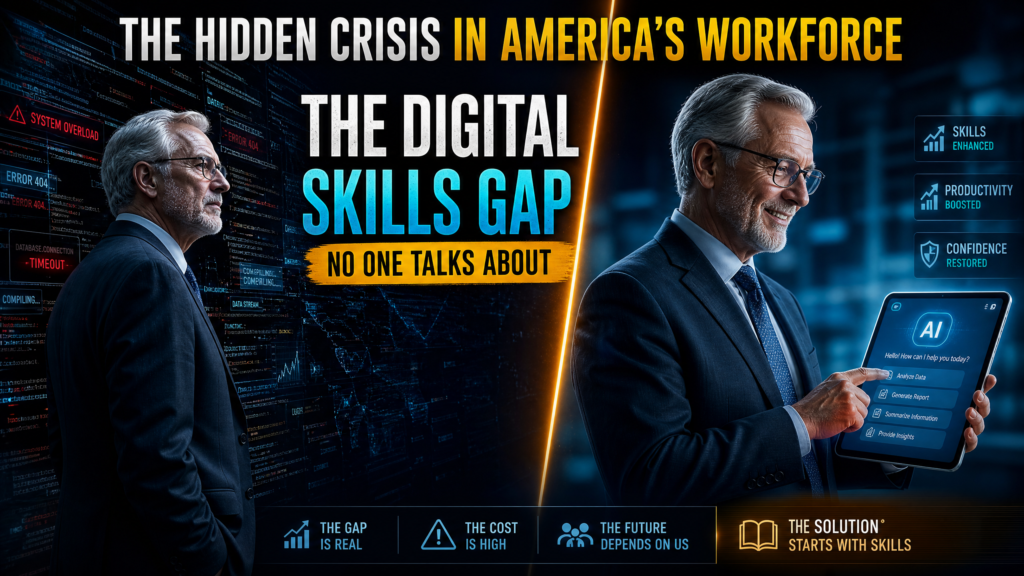
The digital skills gap among older adults is a macroeconomic crisis, but intuitive AI tools offer a powerful bridge back into the workforce.
When policymakers and tech leaders discuss the “digital skills gap,” the conversation almost exclusively revolves around preparing K-12 students for the jobs of tomorrow or retraining millennials whose coding skills have become obsolete. Yet, there is a massive, silent crisis unfolding in the workforce today. The demographic most vulnerable to the rapid acceleration of artificial intelligence is not the youth—it is adults aged 50 to 75.
This age group, which holds decades of invaluable institutional knowledge and life experience, is being systematically excluded from the AI revolution. The consequences of this exclusion extend far beyond personal frustration. It is a macroeconomic issue that threatens to drain billions of dollars from the economy, exacerbate the labor shortage, and push millions of capable older adults into early, involuntary retirement.
The solution is not to force seniors back into traditional, confusing computer classes, but to bridge the gap using intuitive, accessible AI agents for business.
The Scope of the Crisis: By the Numbers
To understand the severity of the issue, we must look at the data. As of 2022, workers aged 55 and older made up 24% of the U.S. workforce, a significant increase from just 10% in the 1990s. However, as the workplace rapidly adopts AI, this demographic is facing unprecedented pressure.
According to the World Economic Forum’s Future of Jobs Report, 90% of jobs in the next decade will require digital skills, yet only 54% of the current workforce possesses them. For older workers, the gap is even more pronounced. The learning curve associated with complex new software platforms is pushing many older professionals out of the workforce entirely.
A recent analysis highlighted that when older workers experience job displacement due to technological shifts, they face significantly greater challenges compared to younger workers, spending more time unemployed and often settling for lower wages if they do return. Some older workers are even opting for early retirement rather than facing the daunting prospect of retraining for an AI-dominated workplace.
“By 2050, the annual economic contributions of the 50-plus age group in the US will triple, from $8.3 trillion to $26.8 trillion. Despite older adults’ potential, digital exclusion remains a significant barrier.”
The Economic Cost of Exclusion
The digital exclusion of adults aged 50–75 is not just a social issue; it is a profound economic failure. When experienced professionals leave the workforce prematurely because they cannot navigate a new software system, businesses lose critical leadership, judgment, and institutional memory—skills that AI cannot replicate.
Furthermore, the economic burden of this digital divide is staggering. A study examining the impact of older adults’ internet use found that active digital engagement could lead to annual cost savings in informal caregiving estimated at $8.1 billion, and up to $20.1 billion with potential health-related improvements. Conversely, digital exclusion correlates strongly with social isolation, which has been linked to a higher risk of developing depressive symptoms and increased healthcare costs.
We cannot afford to let a quarter of our workforce age out simply because the software interfaces are too complex.
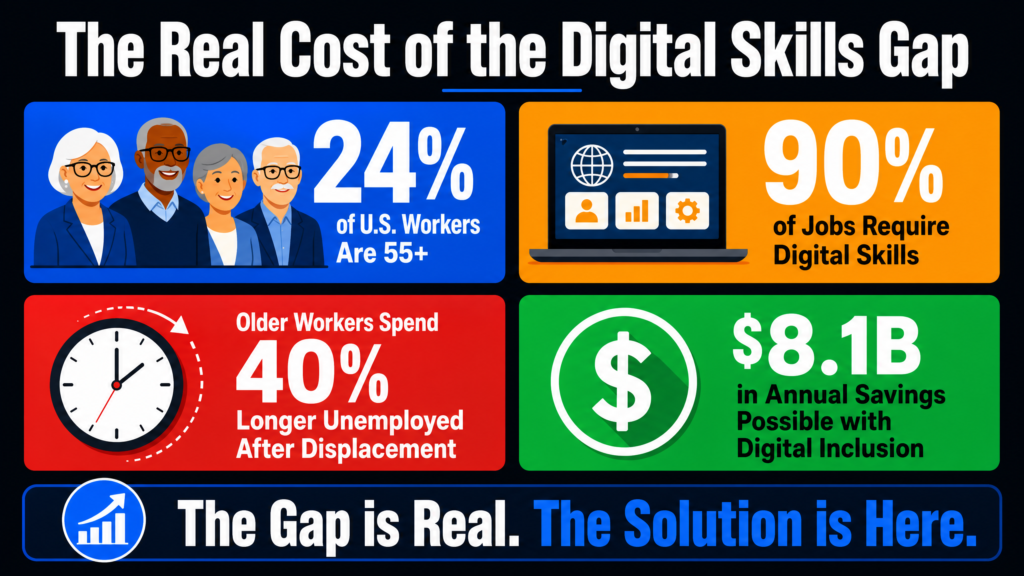
The financial and social costs of leaving older adults behind in the AI revolution are too high to ignore.
The Flawed Approach to “Retraining”
The traditional response from government agencies and corporate HR departments has been to offer “retraining” programs. However, these programs often fail because they are designed by digital natives, for digital natives.
A 65-year-old former operations manager does not need to learn Python. They do not need to understand the underlying architecture of a Large Language Model. What they need is a way to translate their 30 years of operational expertise into digital output without fighting the computer.
When we force older adults to learn complex AI workflows through dense, technical manuals, we are setting them up for failure. The technology should adapt to the user, not the other way around.
Bridging the Gap with SmartPromptIQ
The solution to the digital skills gap for adults 50–75 is to remove the technical friction entirely. This is where SmartPromptIQ fundamentally changes the paradigm.
Instead of teaching older adults how to code or navigate confusing dashboards, SmartPromptIQ provides an AI staff that understands natural language. If a senior wants to start a consulting business, analyze a financial report, or draft a marketing email, they don’t need to learn a new software suite. They simply need to tell the AI what they want to achieve.
How AI Agents Empower Older Adults:
- Natural Language Interfaces: Users interact with the system just as they would speak to a human assistant. There are no complex menus or coding required.
- Guided Workflows: The platform provides step-by-step guidance for common business tasks, ensuring the user never feels lost or overwhelmed.
- Instant Execution: The AI agents for business handle the technical execution—formatting, data processing, and research—allowing the user to focus on strategy and decision-making.
This approach aligns perfectly with the needs of older workers. It leverages their strongest asset—their experience and judgment—while automating the technical tasks that previously acted as a barrier to entry.
A Call to Action for Policymakers and Organizations
Addressing this hidden digital skills gap requires a coordinated effort. Government agencies, nonprofits, and corporate leaders must recognize that digital equity for older adults is a critical economic priority.
Funding from initiatives like the Department of Labor’s Senior Community Service Employment Program (SCSEP) and the National Science Foundation (NSF) must be directed toward intuitive, accessible platforms rather than outdated computer literacy classes.
Organizations that serve older adults must partner with platforms that provide true AI automation for entrepreneurs. By providing seniors with tools like SmartProTradeIQ for financial literacy and SmartDealsIQ for economic empowerment, we can ensure that the AI revolution is inclusive.
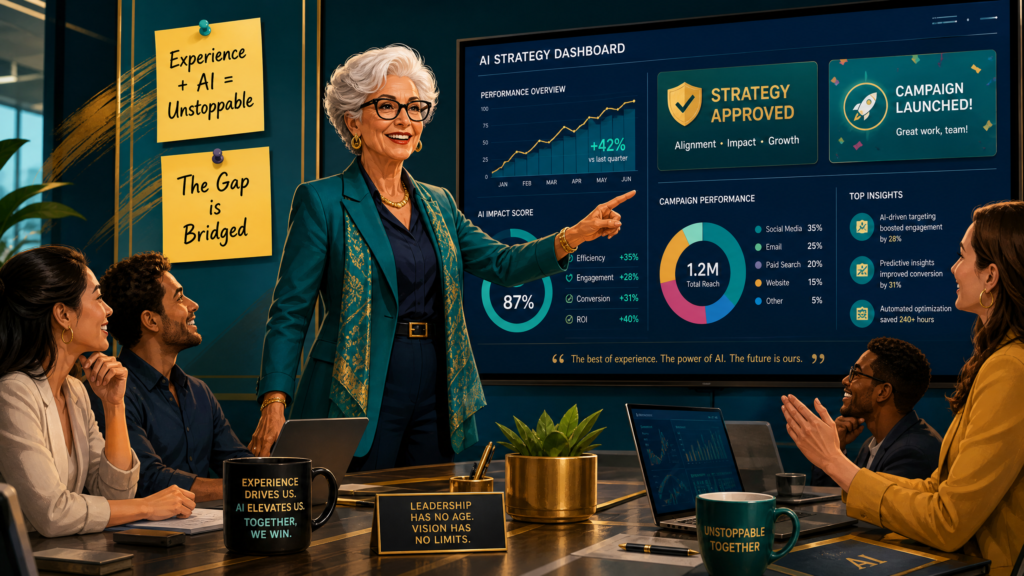
When technology adapts to the user, experience and AI become an unstoppable combination.
The Future of Work is Age-Inclusive
The AI revolution does not have to be a threat to older workers. When implemented correctly, it is the greatest equalizing force in the history of technology.
By utilizing intuitive AI business systems, we can strip away the technical barriers that have historically held older adults back. We can allow a 70-year-old to launch a startup, manage a portfolio, or consult for a major corporation using nothing but their voice and their hard-earned wisdom.
The digital skills gap for adults 50–75 is real, and the consequences of ignoring it are severe. But with the right tools, we can turn this crisis into an unprecedented opportunity for economic growth and generational empowerment.
🚀 Tools Built for Your Experience
Leverage intuitive AI designed to amplify your expertise.
SmartPromptIQSmartPromptIQ StaffSmartMovIQSmartPromptAgentsSmartProTradeIQSmartDealsIQ
Ready to Bridge the Gap?
Discover how intuitive AI can empower you or the community you serve. No coding, no complex manuals—just results.
Try SmartPromptIQ AI Staff FreeDownload 50 AI Staff Workflows
References
- Generations, “Not Left Behind: Older Workers, Artificial Intelligence, and the Data Behind Adoption,” Jun 2026. asaging.org
- World Economic Forum, “Future of Jobs Report 2025,” 2025. weforum.org
- OECD, “Employment Outlook 2025,” Jul 2025. oecd.org
- Fox 47 News, “As AI transforms workplaces, some older workers are opting for early retirement,” Apr 2026. facebook.com/fox47news
- FP Analytics, “Digital Inclusion for All,” 2023. foreignpolicy.com
- ScienceDirect, “Intergenerational relations in the workforce in the age of artificial intelligence,” Jun 2026. sciencedirect.com
- PubMed, “Impact of Older Adults’ Internet Use on Economic Burden of Informal Caregiving,” Jan 2025. nih.gov
- Science, “Digital Exclusion and Depressive Symptoms among Older People,” 2024. science.org