How to Learn AI Prompting: A Practical Path from First Question to Real-World Results
Artificial intelligence is quickly becoming part of ordinary work and everyday life. People use it to brainstorm, write emails, organize information, plan projects, learn unfamiliar topics, and create first drafts. Yet the difference between a frustrating AI experience and a genuinely useful one is rarely technical expertise. More often, it comes down to knowing how to ask clear, purposeful questions. That is the foundation of prompt engineering: giving an AI tool enough context, direction, and detail to produce an answer you can actually use.
For beginners, that idea can feel intimidating. You may wonder whether you need coding skills, a technical background, or hours of free time to learn. You do not. The most effective way to build AI confidence is to learn one practical skill at a time, try it immediately, and improve through feedback. A structured learning environment, such as SmartPromptIQ Academy’s AI prompt engineering courses, can make that progression clearer, more approachable, and far more useful than simply experimenting at random.
Why Learning to Prompt Well Matters
AI tools can produce a great deal of information in seconds, but speed alone does not guarantee quality. A vague request often creates vague output. For example, asking an AI to “write a social media post” leaves it guessing about the audience, platform, purpose, tone, and desired action. A stronger prompt might explain that the post is for a local service business, written for busy homeowners, limited to 100 words, and should end with a friendly invitation to book a consultation.
This is not about finding one magic phrase. It is about communicating your goal with intention. When you can explain what you need, provide relevant background, and tell the AI what a useful answer looks like, you gain more control over the result. That skill can help a marketer create on-brand copy, a job seeker refine a résumé, a small-business owner outline customer messages, or a curious learner make a difficult subject easier to understand.
Start with a Simple, Repeatable Prompt Structure
Good prompts do not need to be long, but they do need to be specific enough to guide the task. A useful starting structure has four parts: the role, the goal, the context, and the format. Tell the AI what job to do, the outcome you want, the details that matter, and how to present the answer.
Imagine you are preparing for an interview. Instead of asking, “Help me get ready,” you could write: “Act as an interview coach. Help me prepare for a customer service manager interview at a retail company. I have five years of team-lead experience. Give me ten likely questions, a short explanation of what each question tests, and a sample answer outline.” The second request gives the AI a clear job, relevant information, and a format that supports action.
Use this pattern for small tasks you already do, such as a meal-planning template, a polite email response, or a home-project checklist. Practical repetition turns a useful framework into a reliable habit.
Learn by Doing, Not Just by Watching
Reading about AI can be helpful, but real progress happens when you test prompts yourself. Start with a question, review the answer, identify what is missing, and try again. This simple cycle—prompt, review, refine—teaches you how to collaborate with an AI system instead of expecting a perfect first result.
Hands-on practice also makes AI feel less mysterious. You begin to see patterns: detailed context usually improves relevance, examples can clarify your expectations, and constraints can make an answer easier to use. For instance, specifying “use plain English,” “include three options,” or “make this suitable for a beginner” can change an otherwise generic response into something much more valuable.
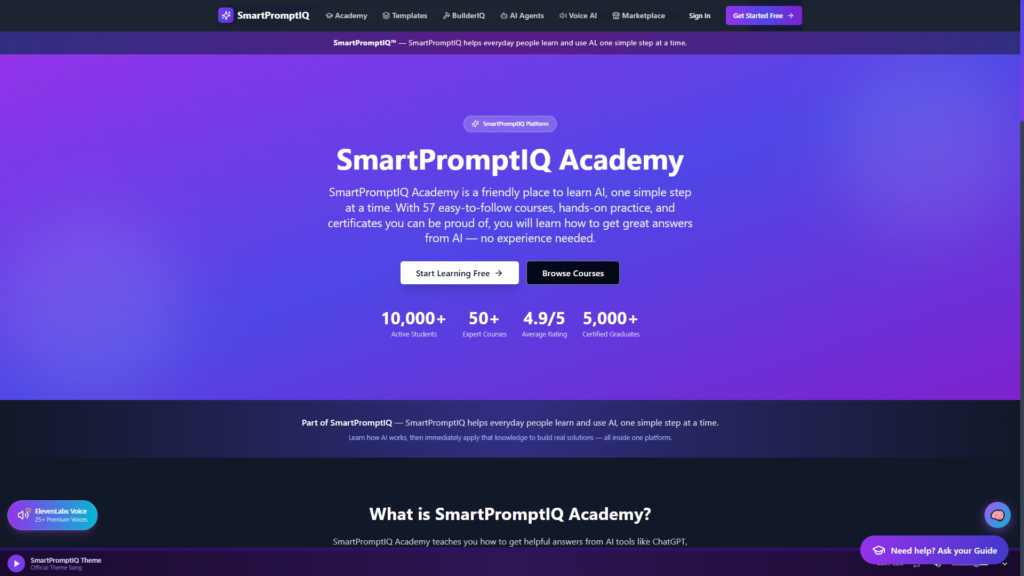
Courses with guided exercises are especially helpful because they give learners a safe place to practice without feeling judged. At SmartPromptIQ Academy, learners can work through practical lessons, apply ideas straight away, and build confidence step by step. That approach is valuable for anyone who prefers learning through clear instruction and immediate application.
Choose Projects That Connect to Your Real Life
The best AI learning projects solve a problem you genuinely have. Business owners can use prompts to describe an offer, organize frequently asked questions, or outline a follow-up sequence. Career changers can identify transferable skills and practice interview answers, while students can turn notes into practice questions.
These small projects do more than produce an immediate result. They show you where AI fits into your own workflow. You also create examples of what you can do, which is useful when building a portfolio or explaining new skills to an employer, client, colleague, or training program. The goal is not to use AI for everything; it is to recognize where it can make routine work clearer, faster, or easier to begin.
Build Confidence with Feedback and Iteration
With AI, confidence usually follows practice. You do not need to understand every technical detail before you can use a tool effectively. A willingness to ask, evaluate, and adjust will help you spot weak prompts and improve them.
Feedback speeds this up. Compare two versions of a prompt and ask which one produced the more relevant answer. Notice how a requested audience changes the language. Test whether a table, checklist, or step-by-step format helps you take action more easily. Over time, you will develop your own prompt library: proven instructions you can reuse and adapt for recurring tasks.
A supportive learning path can help you build that library without getting overwhelmed. The SmartPromptIQ Academy course catalog covers practical applications across marketing, business, development, and creative work, with learning paths designed to move from foundational skills to more advanced use cases. It is a useful option for learners who want a clear sequence rather than disconnected tips.
Keep Your Focus on Useful, Responsible Results
Learning to prompt well also means learning to use AI thoughtfully. Treat AI output as a starting point, not an unquestionable authority. Review important details, check facts when accuracy matters, and protect personal or confidential information. The stronger your judgment, the more valuable your AI skills become.
Set a realistic goal. You do not need to become an expert overnight. Begin by saving ten minutes on one task, then apply what you learn to another. Small wins build momentum and make continued learning worthwhile.
Take the Next Step with AI
AI is most useful when it helps you turn ideas into action. By learning how to provide context, define outcomes, request the right format, and refine your instructions, you can get more helpful answers from the tools already available to you. The process is approachable, practical, and relevant whether you are exploring a new career direction, improving how you work, or simply curious about what AI can do.
If you are ready to move beyond occasional experimentation, explore SmartPromptIQ Academy and begin with a beginner-friendly course. With structured lessons, hands-on practice, and a focus on real-world applications, you can take your first prompt and turn it into a skill you use with confidence.