AI Is Changing Everything — But Seniors Are Being Left Behind. Here’s the Fix
AI Is Changing Everything

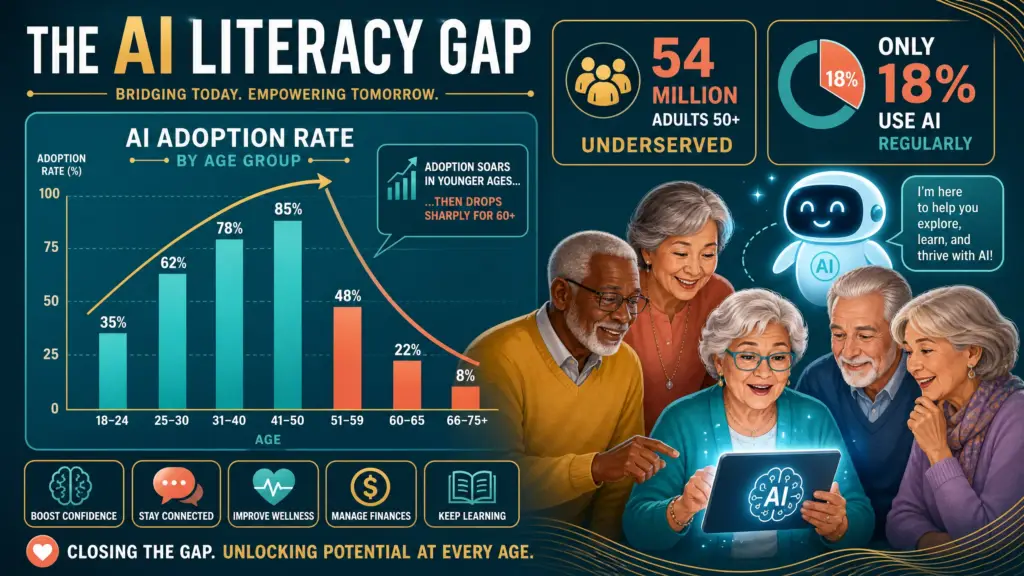
We are living through one of the most rapid technological shifts in human history. Artificial intelligence is no longer a futuristic concept confined to research labs; it is actively rewriting the rules of how we work, how we communicate, and how we access information. However, beneath the headlines celebrating unprecedented productivity and innovation lies a quiet, growing crisis: a massive generational divide. While younger demographics are rapidly integrating AI into their daily routines, millions of adults over the age of 50 are being systematically left behind.
This exclusion is not intentional, but it is structural. The technology industry designs products for early adopters, assuming a baseline of digital fluency that simply does not exist for everyone. As a result, older adults are often met with complex interfaces, confusing jargon, and a steep learning curve that breeds anxiety rather than confidence. According to recent surveys, while generative AI use among older Americans has doubled from 9 percent in 2023 to 18 percent recently, the vast majority still remain disconnected from its benefits [1]. This is not merely an inconvenience; it is a profound societal failure that threatens to isolate an entire generation from the modern economy and digital community.
The solution requires a fundamental shift in how we approach technology education. We must stop expecting seniors to adapt to complex systems and start building systems—and learning environments—that adapt to them. Platforms like SmartPromptIQ are leading this charge, demonstrating that with the right tools, the generational AI divide is entirely solvable.
The Anatomy of the AI Literacy Gap
To understand how to fix the problem, we must first understand why it exists. The AI literacy gap is not caused by a lack of intelligence or a lack of desire to learn among older adults. Rather, it is the result of three distinct systemic failures.
1. Seniors Aren’t Being Taught AI
The traditional avenues for learning new skills often fail older adults when it comes to emerging technology. Community centers and libraries do their best, but they are frequently underfunded and lack the curriculum needed to teach cutting-edge AI concepts. Meanwhile, commercial AI platforms offer little to no onboarding for beginners. When an older adult logs into a popular AI chatbot, they are typically met with a blank text box and a blinking cursor—an intimidating starting point for someone who does not understand what a “prompt” is.
Without structured, beginner-friendly education, older adults are forced to rely on trial and error, which often leads to frustration and abandonment. They need a Senior AI Learning Center that starts at zero, explaining concepts in plain language before introducing complex tasks.
2. Adult Children Don’t Have the Time (or the Patience)
Historically, younger family members have served as informal IT support for older generations. However, the complexity and rapid evolution of AI make this dynamic unsustainable. Adult children are often overwhelmed by their own careers and family responsibilities. When they do try to help, the sessions are frequently rushed and frustrating for both parties.
Teaching someone how to effectively use AI requires patience, repetition, and a structured curriculum. An exasperated phone call explaining how to write a prompt is not a substitute for a comprehensive educational platform. When families lack the tools to bridge the gap, the older adult is left feeling like a burden, further discouraging them from engaging with the technology.
3. Organizations Lack the Training Infrastructure
Many organizations that serve older adults—such as nonprofits, senior living communities, and workforce development boards—recognize the importance of digital literacy. However, they simply do not have the resources or the expertise to develop an AI curriculum from scratch. They need turnkey solutions that can be easily integrated into their existing programs.
This is particularly critical for programs aimed at helping older adults re-enter the workforce. The Department of Labor and programs like the Senior Community Service Employment Program (SCSEP) recognize that digital skills are essential for employment [2]. Yet, without accessible training platforms, these organizations struggle to prepare their participants for a job market that increasingly demands AI proficiency.
Why AI Literacy is Becoming Mandatory
Some might argue that older adults do not “need” to learn AI. They have managed fine without it so far. This perspective, however, fundamentally misunderstands the trajectory of technology. AI is not a niche tool; it is becoming the underlying infrastructure of the digital world.
The Economic Imperative
For adults over 50 who are still working, looking for employment, or trying to supplement their retirement income, AI literacy is rapidly shifting from a “nice-to-have” to a mandatory requirement. A recent McKinsey report noted that 84 percent of international employees receive significant organizational support to learn AI skills, highlighting the global push for AI competency in the workplace [3].
Older workers who lack these skills face a significant competitive disadvantage. Conversely, those who embrace AI can leverage it to update resumes, automate administrative tasks, and even launch micro-businesses. By utilizing **prompt engineering tools** and accessible **AI workflows**, seniors can remain active and competitive in the modern economy.
The Security Imperative
Perhaps even more urgently, AI literacy is a critical component of personal security. As discussed in previous articles, scammers are using AI to execute highly sophisticated fraud campaigns, including voice cloning and hyper-personalized phishing attacks. The Federal Trade Commission continually highlights the disproportionate financial impact these scams have on older consumers [4].
You cannot effectively defend against a threat you do not understand. Teaching older adults how AI can be used to manipulate audio and text is the first step in helping them recognize the red flags of a modern scam. A comprehensive education must include tools like the SmartPromptIQ Fraud Analyzer, which empowers seniors to independently verify suspicious communications.
The Fix: A Blueprint for Generational Empowerment
The generational AI divide is a massive challenge, but it is not insurmountable. Fixing it requires a departure from the “sink or swim” approach of the broader tech industry. We must build platforms that prioritize accessibility, community, and practical application.

Community Onboarding and Plain Language
The most effective way to introduce older adults to AI is through community onboarding. Learning in a supportive, group environment—whether physical or virtual—removes the stigma of asking beginner questions. It transforms a solitary, frustrating experience into a shared journey of discovery.
Furthermore, the instruction must be delivered in plain language. We must banish terms like “large language models,” “tokens,” and “parameters” from introductory courses. Instead, we should focus on the practical outcomes: “Here is how to ask the computer to write a polite email to your landlord.” By focusing on utility over technical specifications, we make the technology approachable.
Actionable Blueprints and AI Staff
Beginners should never be forced to stare at a blank screen. To bridge the gap, we must provide actionable blueprints—step-by-step templates that guide the user through specific tasks. Whether it is planning a weekly grocery budget, drafting a cover letter, or summarizing a lengthy medical document, blueprints remove the guesswork from prompt creation.
For those looking to manage more complex tasks, the concept of an AI Staff is revolutionary. Instead of learning how to program a computer, the user learns how to manage a digital assistant. This paradigm shift makes advanced technology accessible to anyone who knows how to give clear instructions, effectively turning an intimidating **AI business system** into a friendly, manageable tool.
A Turnkey Solution for Organizations
To scale this solution, we must empower the organizations that already serve older adults. Platforms like SmartPromptAgents provide the infrastructure that libraries, senior centers, and workforce boards need. By offering a ready-made curriculum, these organizations can focus on what they do best: supporting their community.
Conclusion: Bridging the Gap Together
The narrative that seniors are incapable of adapting to new technology is both false and damaging. When provided with the right tools, a supportive environment, and clear, jargon-free instruction, older adults are more than capable of mastering artificial intelligence. They simply need a bridge to cross the divide.
SmartPromptIQ is building that bridge. By combining a dedicated Senior AI Learning Center, practical tools like the Fraud Analyzer, and the empowering capabilities of an AI Staff, they are proving that the benefits of the AI revolution belong to everyone, regardless of age. It is time we stop leaving our parents and grandparents behind and start inviting them into the future.
Try SmartPromptIQ AI Staff free and Download 50 AI Staff workflows to start your journey toward confident and safe AI usage today! Explore the possibilities at SmartPromptIQ AI Staff.
References
[1] AARP: Older Americans are Leveraging More Technology
[2] U.S. Department of Labor: Senior Community Service Employment Program (SCSEP)
[3] McKinsey & Company: AI in the workplace: A report for 2025
[4] FTC: Protecting Older Consumers 2024–2025