AI Engineering Programs That Build Real Skills
Most people do not need another AI course. They need AI engineering programs that help them move from curiosity to capability, and from capability to shipped systems.
That difference matters. A lot of programs teach concepts, model families, and industry vocabulary. Fewer teach you how to design prompts that hold up in production, connect models to tools, structure workflows, evaluate outputs, and turn a rough idea into something users can actually touch. If your goal is to build, not just browse, the bar should be higher.
What AI engineering programs should actually teach
The phrase sounds broad because it is. AI engineering programs can range from university degrees to bootcamps to product-led academies. But for builders, the real question is simpler: does the program prepare you to create working AI systems under real constraints?
A useful program should cover the full stack of practical AI work. That starts with fundamentals like how language models behave, where they fail, and how context shapes output. But it cannot stop there. You also need prompt design, retrieval patterns, agent workflows, evaluation methods, system architecture, safety controls, and deployment thinking.
If a program teaches prompting as a bag of clever text tricks, that is a warning sign. In real products, prompts are only one layer. They interact with memory, tools, user states, APIs, business logic, and cost limits. Good AI engineering is closer to system design than magic wording.
The strongest programs also teach judgment. When should you use a single prompt versus a multi-step workflow? When is an agent useful, and when is it overkill? When should you fine-tune, and when should you leave the base model alone? Those trade-offs are where beginner enthusiasm usually crashes into production reality.
The gap between learning AI and shipping AI
This is where many learners lose momentum. They finish a few lessons, understand the buzzwords, maybe even generate decent outputs, but still cannot build a reliable tool. The missing layer is execution.
Execution means translating an idea into components. You need a use case, a user flow, a prompt strategy, a way to handle errors, a framework for testing, and some path to deployment. Without that structure, learning stays abstract.
That is why the best AI engineering programs feel closer to a builder environment than a digital textbook. They do not just explain what an AI agent is. They help you map one to a business problem, define inputs and outputs, and turn that logic into a blueprint you can refine and ship.
For entrepreneurs and operators, this matters even more. You are not studying AI for academic credit. You are trying to reduce support load, launch a product feature, automate research, create a niche assistant, or package an internal workflow into a service. The value is in implementation speed.
How to judge AI engineering programs before you enroll
A polished curriculum page does not tell you much. You need to look under the hood.
First, check whether the program is outcome-based or content-based. Content-based programs are organized around topics. Outcome-based programs are organized around what you will be able to build. Both can work, but if you care about execution, outcomes matter more.
Second, inspect the practice layer. Are there projects, blueprints, guided builds, or system design exercises? Or are you mostly watching videos and taking quizzes? Passive learning is fine for orientation. It is weak preparation for product work.
Third, look for production-minded skills. That includes prompt versioning, evaluation, orchestration, tool calling, workflow logic, latency awareness, and cost considerations. Even if you are a beginner, exposure to these topics changes how you build.
Fourth, pay attention to accessibility and workflow flexibility. If a platform supports voice-powered learning and building, for example, that can be more than a convenience. It can make the difference between consuming lessons passively and actually building while you work, commute, or multitask.
Finally, ask what happens after the lesson ends. Do you leave with notes, or with assets you can use – prompt systems, app specs, workflow plans, agent structures, deployment guidance? The best programs compress the path from education to execution.
The main types of AI engineering programs
Not all programs are solving the same problem, so choosing the right category matters.
University and academic programs
These are strongest when you want depth in math, machine learning theory, computer science, or research foundations. They can be excellent for long-term technical credibility. But they often move slower than the market and may not focus on shipping AI products with current tools.
If you want to become an ML researcher or pursue a highly technical engineering path, this route can make sense. If you want to launch AI products in the next six months, it may not be the fastest path on its own.
Bootcamps and cohort programs
These are built for speed. The good ones create momentum, accountability, and real project work. The weak ones compress too much information into too little time and leave students with surface-level familiarity.
This format works well for people who need structure and deadlines. It is less ideal if you want to learn at your own pace or revisit systems repeatedly while you build.
Product-led AI builder platforms
This category is increasingly relevant because the market now rewards applied skill more than passive knowledge. These programs combine learning with tools, templates, and system outputs you can act on immediately.
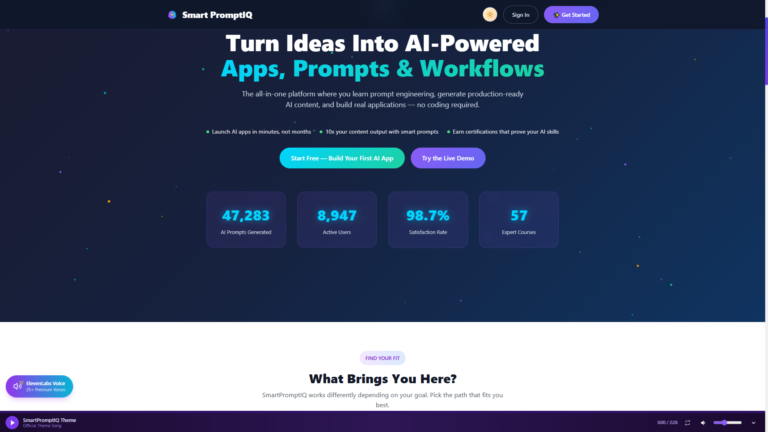
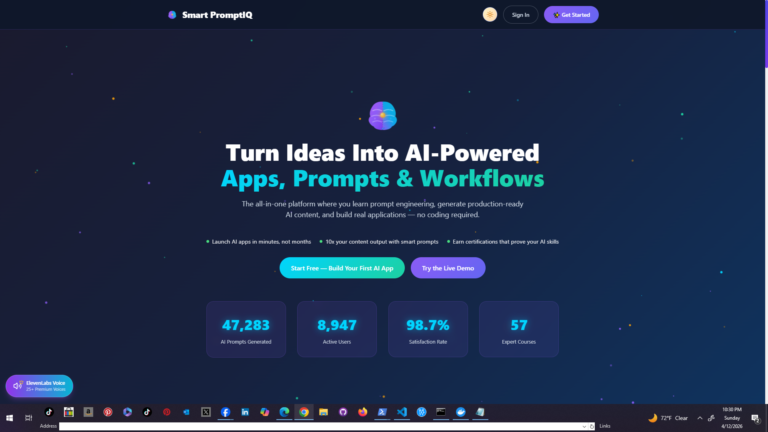
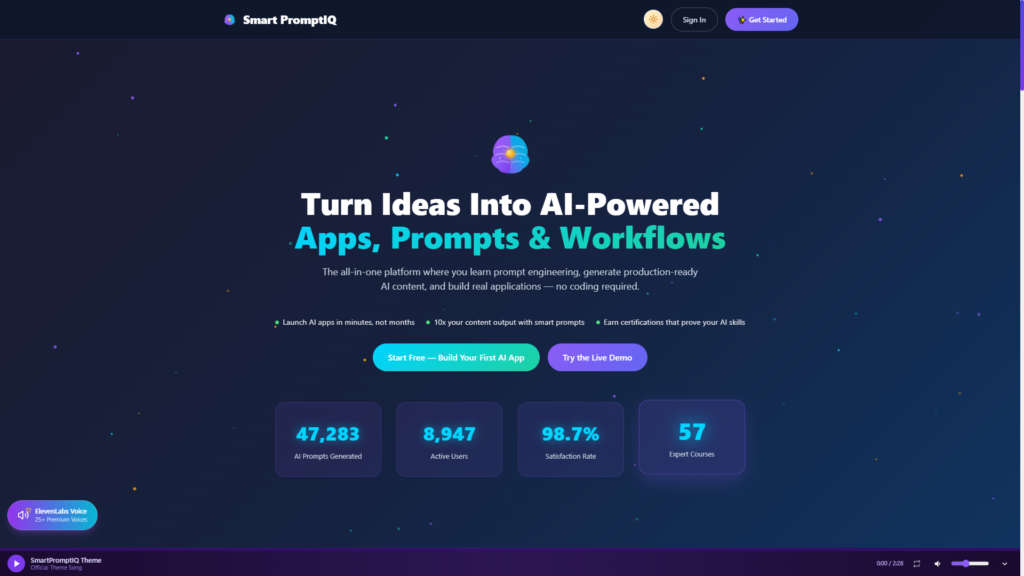
That model is especially useful for founders, creators, consultants, and operators. Instead of learning in one place and building in another, you learn inside the same environment where you generate prompts, workflows, blueprints, and agents. SmartPromptIQ fits this model by pairing structured AI education with builder tools that help users move toward deployable systems instead of stopping at theory.
Skills that matter more than brand names
People often ask which credential is best. In AI, that is not always the right question.
Hiring managers, clients, and users care about what you can build and how reliably it works. A famous institution can help open doors, but it does not automatically mean you can architect a useful AI workflow or debug a failing agent chain.
The skills with the highest practical value tend to be compositional. Can you break a problem into model-friendly tasks? Can you choose between prompt chaining, retrieval, and tooling based on the use case? Can you evaluate outputs systematically instead of relying on intuition? Can you write instructions that survive edge cases and user variability?
These are engineering habits, not just AI habits. They are what separate someone who experiments well from someone who ships well.
Red flags to watch for
Some AI engineering programs are still selling a 2023 version of the market. They overpromise easy automation, underteach evaluation, and treat prompting like a shortcut to technical rigor.
Be cautious if a program focuses heavily on hype terms with little implementation detail. Be cautious if every project looks like a toy demo. Be cautious if deployment, cost, reliability, and iteration are barely mentioned.
Another red flag is fragmentation. If a program gives you disconnected lessons on prompting, agents, monetization, and app building without showing how those pieces work together, you may finish informed but still stuck. Real momentum comes from integration.
How to choose based on your goal
If you are a beginner, choose a program that gives you strong structure, clear progression, and fast wins. You need confidence early, but you also need a path into deeper system thinking.
If you are already technical, look for leverage. The right program should accelerate execution, not slow you down with basics you can self-study. Tools, reusable patterns, and production-ready frameworks matter more here.
If you are a founder or operator, prioritize programs that map directly to business outcomes. You want to validate ideas, build prototypes, automate workflows, and move toward deployment. A program that stops at education will feel incomplete.
And if your goal is career transition, choose a path that leaves you with a portfolio of working systems. In a crowded market, proof beats familiarity.
The best AI engineering programs do not just help you understand the technology. They help you think like a builder under real constraints, with real users and real trade-offs. That is the shift that turns AI from an interesting subject into a practical advantage. Choose the program that gets you there faster, then use it to make something worth shipping.