
AI Prompt Engineering Education That Builds
Most people do not need more AI content. They need better AI prompt engineering education – the kind that helps them go from vague ideas and scattered prompts to systems that actually work.
That gap matters. A lot of prompt engineering advice still treats the skill like a bag of tricks: use this framework, copy that prompt, add more context, try another model. Useful for five minutes, maybe. But if you are trying to build a customer support copilot, automate research, launch an internal workflow, or turn expertise into an AI product, prompts alone are not the finish line. They are one layer in a larger system.
What AI prompt engineering education should actually teach
Good education in this space should do more than explain how to ask an AI better questions. It should teach how language interfaces shape outputs, how model behavior changes with context, and how prompting fits into product design, reliability, and user experience.
That means learning to write effective prompts, yes, but also learning when prompting is not enough. If your AI task breaks under slight wording changes, fails on edge cases, or produces answers that cannot be trusted in a business setting, the problem is not always your wording. Sometimes you need clearer system instructions, better input structure, retrieval, chaining, evaluation, or human review.
This is where a lot of learners get stuck. They study prompting as an isolated skill, then hit a wall when they try to build something real. The output looks promising in a chat window, but it falls apart in production.
The problem with theory-heavy prompt training
There is nothing wrong with fundamentals. You need them. But AI moves too fast for education that stays trapped in definitions and surface-level examples.
A theory-heavy course may teach zero-shot versus few-shot prompting, role prompting, chain-of-thought style scaffolding, or output formatting. Those concepts matter. What it often misses is execution. How do you turn a prompt into a reusable workflow? How do you structure prompts for customer inputs you do not control? How do you test quality across dozens of scenarios instead of one polished demo?
For builders, operators, and founders, this is the real standard. If the education does not help you produce a reliable output, reduce iteration time, and move toward deployment, it is incomplete.
The best learning experience gives you both sides: conceptual clarity and applied build work. You should understand why a prompt works, then use that understanding to create agents, workflows, automations, and product logic that hold up outside the classroom.
AI prompt engineering education for builders, not spectators
If your goal is to ship, your education has to mirror that outcome.
That means working on tasks that resemble actual use cases: lead qualification, research assistants, onboarding flows, proposal generation, support triage, content pipelines, voice interactions, and operational copilots. When you practice in that context, prompt engineering stops feeling like a novelty skill and starts becoming part of systems thinking.
Builders need to learn how to define a task clearly, break it into components, assign the right instructions, set output constraints, and decide where automation ends and oversight begins. They also need exposure to failure modes. A prompt that sounds smart but produces inconsistent outputs is not a win. A simpler prompt tied to better process design often performs better.
This is one reason platform-based learning tends to outperform random tutorials. When education sits next to build tools, the feedback loop gets shorter. You learn a concept, test it, refine it, and move closer to a usable product. That is far more valuable than collecting templates you may never apply.
What to look for in a serious prompt engineering program
A credible program should feel like skill development with output attached. Not just lessons, but a path.
First, it should be structured. Prompt engineering is easy to underestimate because the entry point is simple. You type instructions into a model. That creates the illusion that mastery is also simple. It is not. A strong curriculum should move from core prompting principles into workflows, system prompts, agents, evaluation, business use cases, and deployment logic.
Second, it should be practical. You want exercises that force decisions, not passive examples. Good training asks you to improve weak prompts, diagnose failures, create repeatable prompt systems, and adapt them to different models and user inputs.
Third, it should connect prompting to products. This is where many courses fall short. They teach interaction but not implementation. If you want to launch something real, you need to understand blueprints, task flows, user states, monetization options, and technical architecture at a level that helps you execute.
Fourth, it should support different levels of experience. Beginners need clarity and sequence. More advanced users need acceleration. The ideal environment does both without talking down to either group.
Why prompt engineering is no longer just about prompts
The term still matters, but the field has widened.
Today, effective prompt work often sits inside larger systems that include memory, retrieval, tools, APIs, multi-step logic, and voice interfaces. The person who understands prompting but cannot connect it to execution will hit limits quickly. The person who can combine prompt design with system design becomes much more valuable.
That shift changes what education should prioritize. Instead of treating prompt engineering like a standalone craft, serious programs should teach it as a control layer for AI behavior within broader applications. You are not just asking for an answer. You are shaping how an AI function operates inside a workflow, product, or business process.
This is especially true for teams building customer-facing tools. Reliability, consistency, safety, and speed matter more than clever prompt phrasing. Education should prepare learners for those constraints instead of pretending every use case lives inside a perfect demo environment.
The trade-off between speed and depth
A lot of people want the shortcut. That is understandable. AI rewards speed, and the market moves fast.
But there is a difference between moving fast and skipping foundations. If you only learn copied formulas, you may get early wins, but you will struggle to troubleshoot, adapt, and scale. If you only study deeply without building, you will understand concepts but stay stuck in planning mode.
The right approach sits in the middle. Learn the key principles quickly, then apply them to real build scenarios with increasing complexity. That gives you momentum without making your skillset fragile.
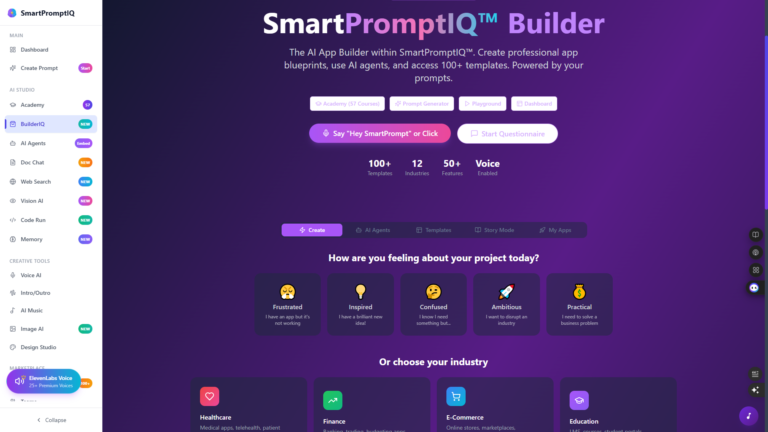
For some users, especially founders and operators, the best educational model is one that compresses this cycle. Learn, test, build, revise, deploy. Repeat. SmartPromptIQ is built around that exact progression, which is why the education side makes more sense when paired with tools that help turn knowledge into blueprints, agents, workflows, and production-ready systems.
How to know your AI prompt engineering education is working
The signal is not whether you can explain prompting jargon. The signal is whether you can create outputs that are more consistent, more useful, and easier to operationalize.
You should notice that you write instructions with more precision. You recover faster when outputs fail. You spend less time guessing and more time designing. You start seeing prompts as components inside a larger architecture, not as magic text blocks.
You should also be able to translate ideas into build plans. If someone says, “I want an AI assistant that handles intake, organizes responses, and routes next steps,” you should know how to think through prompt logic, workflow stages, fallback behavior, and user experience. That is applied education.
A strong learning path also changes your confidence. Not empty confidence – earned confidence. The kind that comes from knowing you can take a concept, structure it, pressure test it, and make it useful.
Where this is heading next
AI interfaces are getting easier. Expectations are getting higher.
That means prompt engineering education will matter more, not less. But the version that wins will not be the most academic or the most hyped. It will be the one that helps people produce real outcomes across text, voice, agents, workflows, and deployable products.
The opportunity is bigger than learning how to talk to a model. It is learning how to design AI behavior with intent, connect it to a system, and ship something that solves a real problem.
If you are choosing where to invest your time, choose education that leaves you with more than notes. Choose the kind that leaves you with something built.