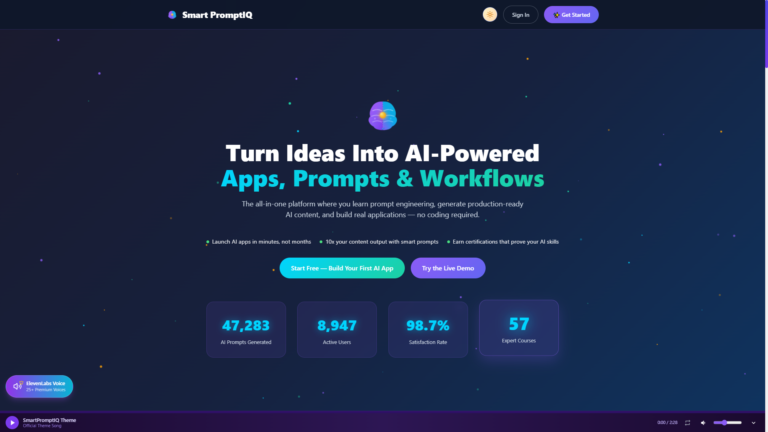
The Future of AI Workflows: Why AI Agents Will Replace 80% of Manual Tasks by 2027
I spent three hours last Tuesday copying data between spreadsheets, reformatting a client report, and sending follow-up emails that said almost the exact same thing. Three hours. Gone. And the worst part? I knew the whole time that none of it required me to actually think.
That experience is what pushed me deeper into building SmartPromptIQ — and it’s why I’m convinced that by 2027, AI agents will handle roughly 80% of the manual tasks that eat up our workdays right now. Not because the tech is some far-off dream. Because it’s already here, and it’s moving fast.
Let me break down what’s happening, why it matters, and how you can get ahead of it.
So What Exactly Is an AI Agent?
You’ve probably used AI tools before. ChatGPT, Copilot, maybe a writing assistant or two. Those are great, but they work like a really smart employee who only does exactly what you ask, one task at a time. You prompt, they respond, you prompt again.
An AI agent is different. Think of it as an employee who understands the goal, not just the instruction. You tell an AI agent “handle my incoming support tickets, categorize them by urgency, draft responses for the easy ones, and flag the complex ones for my team.” Then it goes and does all of that — autonomously. It makes decisions along the way. It connects to your tools. It loops back if something doesn’t look right.
The difference between a chatbot and an agent is the difference between a calculator and an accountant. One does what you punch in. The other understands the bigger picture and takes action on your behalf.
AI agents can chain together multiple steps, use different tools, pull in context from your data, and execute workflows without you babysitting every click. That’s the leap we’re living through right now.
The Numbers Don’t Lie
McKinsey estimated that about 60-70% of work activities could be automated with current technology. Gartner has predicted that by 2026, over 80% of enterprises will have deployed AI agents in some form. And if you look at the trajectory of tools launching in just the last twelve months — from autonomous coding assistants to AI-driven customer service platforms — the acceleration is undeniable.
But here’s what makes me say 80% of manual tasks specifically: most of our daily work isn’t creative problem-solving. It’s moving information from point A to point B. It’s formatting. It’s scheduling. It’s data entry, status updates, follow-ups, and report generation. That stuff is ripe for agents.
The creative, strategic, deeply human work? That’s staying with us. And frankly, when agents take the busywork off your plate, you get to do more of the work that actually matters.
Real Use Cases That Are Already Working
This isn’t theoretical. Here’s what AI agents are doing right now, today, across different industries.
Customer support. Companies are deploying agents that read incoming tickets, pull up the customer’s history, draft a personalized response, and either send it automatically or queue it for a human to review. Resolution times are dropping by 40-60% in some cases.
Sales outreach. Agents that monitor your CRM, identify leads going cold, draft re-engagement emails with personalized context, and schedule them — all without a sales rep lifting a finger until it’s time for a real conversation.
Content operations. Marketing teams are using agents to repurpose a single blog post into social media threads, email newsletters, and ad copy. One piece of content, five distribution channels, zero copy-paste.
Internal operations. Agents that handle employee onboarding workflows — sending welcome emails, provisioning tool access, scheduling orientation meetings, and checking in on day three. HR teams are getting hours back every week.
Data processing. Finance teams running agents that pull transaction data, reconcile it against invoices, flag discrepancies, and generate summary reports. What used to take a full day now runs in the background.
These aren’t edge cases anymore. They’re becoming standard operating procedure for teams that refuse to waste time on work a machine can handle.
Why No-Code AI Changes Everything
Here’s where it gets really interesting for me personally — and for what we’re building at SmartPromptIQ.
The early wave of AI automation required engineers. You needed someone who could write Python scripts, manage API integrations, and troubleshoot broken pipelines. That locked out 90% of the people who could benefit most from automation: small business owners, freelancers, marketing teams, operations managers.
No-code AI flips that on its head. Platforms that let you build, customize, and deploy AI agents without writing a single line of code are democratizing automation in a way we haven’t seen before. You describe what you want the agent to do, connect your tools, set your rules, and let it run.
That’s the core of what SmartPromptIQ is about. We believe the people closest to the work should be the ones automating it — not waiting in a queue for an engineering team to build something six weeks from now.
When a solopreneur can build an AI agent that handles their invoice follow-ups in twenty minutes, something fundamental has shifted. The barrier isn’t technical skill anymore. It’s awareness. Most people just don’t know this is possible yet.
How SmartPromptIQ Agents Work
I want to be transparent about our approach because I think it matters.
SmartPromptIQ is built around the idea of context-driven AI agents. That means our agents don’t just follow a script — they understand your specific business context. Your tone of voice. Your customer segments. Your internal processes. The way your team actually works, not some generic template.
You start by defining the task and giving the agent context. Maybe that’s your brand guidelines, a few example responses, or a description of your workflow. Then you set the triggers — what kicks the agent into action. An incoming email, a new row in a spreadsheet, a Slack message, a scheduled time.
From there, the agent handles the execution. It can draft content, process data, send messages, update records, and loop in a human when it encounters something outside its confidence level. You stay in control. The agent does the heavy lifting.
What makes this different from basic automation tools is the intelligence layer. Traditional automation is “if this, then that.” AI agents are “understand this situation, decide the best action, and execute it.” It’s a fundamentally different capability.
What This Means for You in 2025 and Beyond
If you’re reading this and thinking “okay, but I’m not ready for this yet” — I’d push back gently. The teams that start building AI workflows now are going to have a serious competitive advantage over the next two years. Not because the technology is perfect, but because learning to work with agents is a skill, and that skill compounds over time.
Start small. Pick one workflow that eats up your time every week. Maybe it’s sorting emails, generating reports, or following up with leads. Build an agent to handle it. See what happens. Iterate.
The companies that thrive in the next few years won’t necessarily be the ones with the biggest teams or the most funding. They’ll be the ones that figured out how to multiply their output by putting AI agents to work on the stuff that doesn’t need a human brain.
And honestly? Once you experience what it feels like to get three hours back in your day — those three hours I lost to spreadsheets last Tuesday — you won’t want to go back.
Ready to See It for Yourself?
We built SmartPromptIQ to make this accessible. No engineering degree required. No six-month implementation timeline. Just you, your workflow, and an AI agent that actually understands what you’re trying to get done.
Build your first AI agent today →
The future of work isn’t about doing more. It’s about doing what matters — and letting AI handle the rest.
Written by the SmartPromptIQ team. We’re building the tools that make AI automation accessible to everyone — not just engineers.